
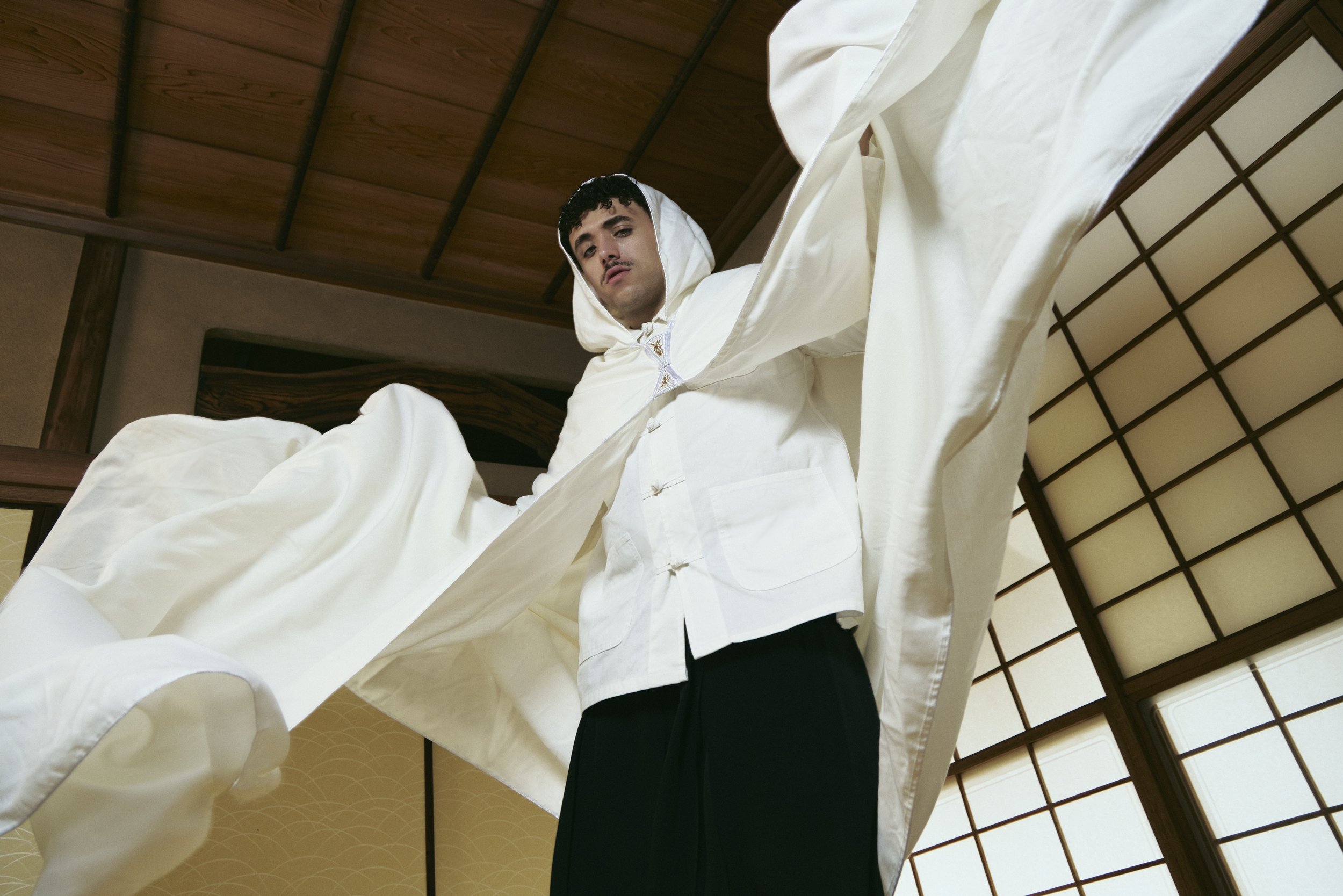
Some conversations don’t need words, as Raï-artist Elias explores in Tokyo
Ahead of a trip to Tokyo, French-Algerian Raï-artist Elias started researching the cultural crossover between his homeland and Japan. Seeking out the heart of the shared Venn diagram between these geographically disparate nations, he worked with Brazilian photographer Analicia Graça and Tokyo-based French-Algerian stylist Zinedine Belfaci to explore the themes he found through three distinct scenes uniting historical and contemporary references.
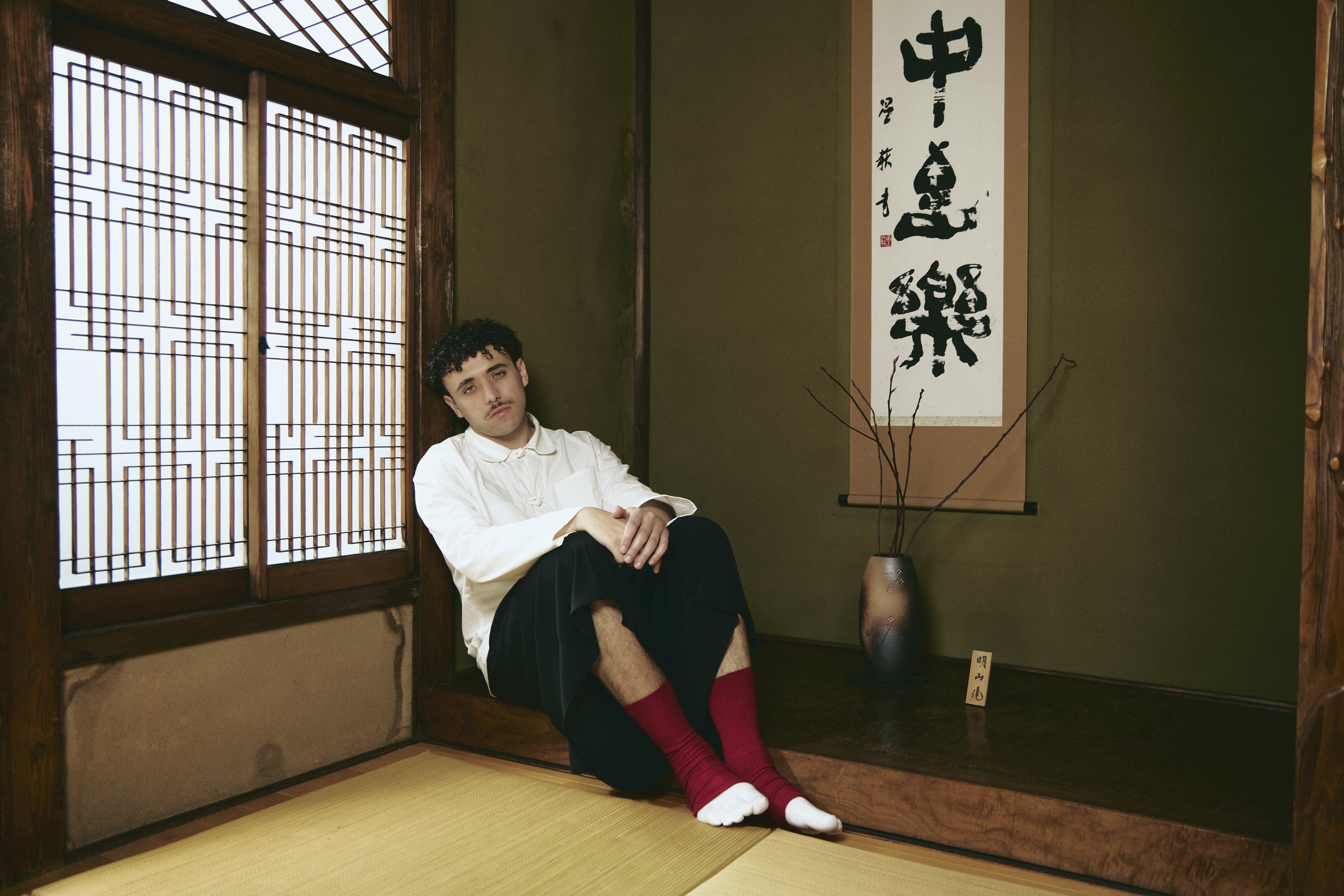
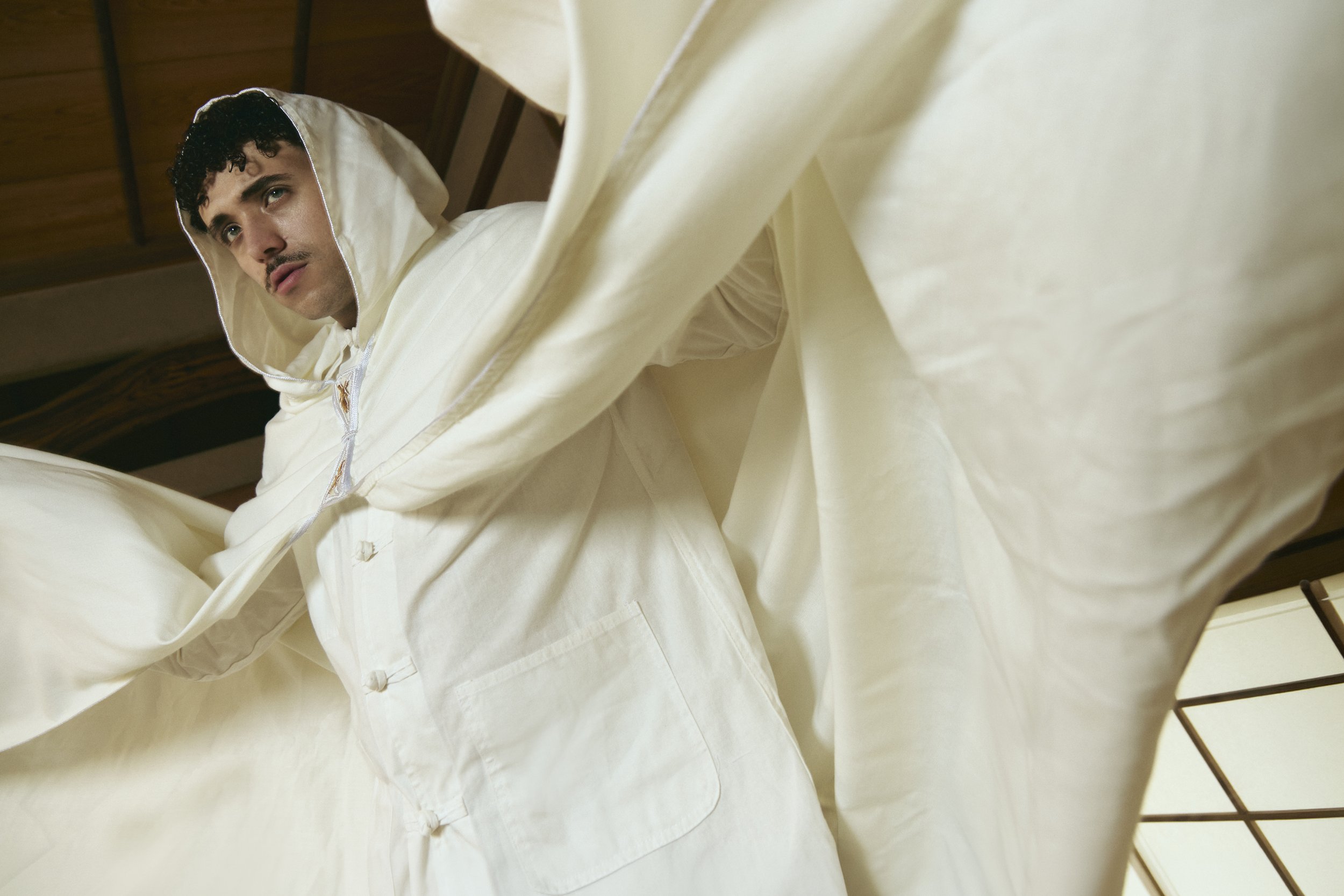
Both countries, rich in culture, have proud traditions of craftsmanship. To represent that side of Algeria, Elias worked with Melissa of Zaphira Archives, who preserves traditional Algerian garments. The brand generously loaned its Kaftan al Kadi from Constantine, which is over 150 years old and was showcased by UNESCO last year. This historical beauty appears in the 3ami-San set, which Elias describes as, “A tribute to heritage and the quiet dignity of those who preserve it; It reflects the deep reverence both Algerian and Japanese cultures hold for their elders — for their wisdom, craftsmanship and the values they pass down.” Set in an old gallery in Tokyo, details include Algerian currency and nods to both cultures’ traditions of afterwork socialising.
Meanwhile the Algerian burnous, a cloak traditionally made from wool and worn by men, finds itself perfectly at home in the Wabi-Sabi set. The traditional tatami room invokes Algerian hospitality with its more-the-merrier approach to gatherings, as well as the calm spirituality that is woven through everyday life. “This chapter explores the quiet harmony between Algerian and Japanese traditions, where restraint and simplicity reveal inner beauty,” explains Elias.” The Japanese ideal of Wabi-Sabi finds perfection in imperfection – it’s commonly expressed through kinsugi, which sees broken pottery repaired by gold, making the damaged pot more valuable than it was to begin with. In Algeria, it’s found in the knowledge and acceptance that only Allah is perfect.
The final Raïajuku set compares Raï culture from Oran with Harajuku’s riotous, youth-led fashion scene. “Vibrant, rebellious and unapologetically bold, this set celebrates youth as a force of self-expression in both Algeria and Japan,” says Elias. “It portrays fashion as language – a way for young people to claim identity, individuality and freedom within society.” For this scene, it was important for the young Raï star to collaborate with and showcase talent from Japan as well as his own artistic world.
Meet his gang – as told by Elias.
AKIMANE
“Akimane is a Japanese model. With a growing presence in editorial and creative projects, he represents a new generation of talent emerging from the Japanese fashion scene. Looking ahead, he plans to expand his career internationally. Beyond modeling, Akimane aspires to open his own Japanese fashion shop amd build a bridge between tradition, contemporary design and international audiences.”
AOÏ
“Aoï is a French-Japanese creative based in Tokyo. She works as a hairdresser moving between Paris and Tokyo. And as a content creator, Aoï is deeply hands-on in her creative practice. She’s currently exploring grillz-making and jewellery design, and has developed a strong eye for vintage fashion, particularly in Tokyo, where she sources archival pieces. Her work reflects a tactile, intuitive creativity rooted in both cultures.“
HANAN
“Hanan is a Syrian-Palestinian creative raised in Paris, whose work revolves around fashion, culture and coffee. Living between Paris, Seoul, Amsterdam and Dubai, she is the founder of Barjis, a traveling café concept designed as a platform for connection and storytelling. In parallel, Hanan works as a creative consultant for brands and also models and creates content. At the core of everything she builds is a commitment to intention, authenticity and cultural depth.’
ELIAS
“Elias is a French-Algerian singer-songwriter based in Paris. Through music, visuals and storytelling, he highlights Algeria’s cultural richness, often drawing inspiration from vintage references and the sentimental era of raï music, to create a world that feels both timeless and contemporary. At the heart of Elias’s work is a desire to build bridges between cultures, using art as a way to reveal shared emotions, histories and similarities across countries and continents.”
Creative direction Elias
Photography Analicia Graça
Styling Zinedine Belfaci
Assistance Malcolm Kun
Caftan el Kadi Melissa
Fashion Safran World
Talent Hanan Al Badri,
Akima Abe,
Aoï Watanabe
Published on 24/04/2026