
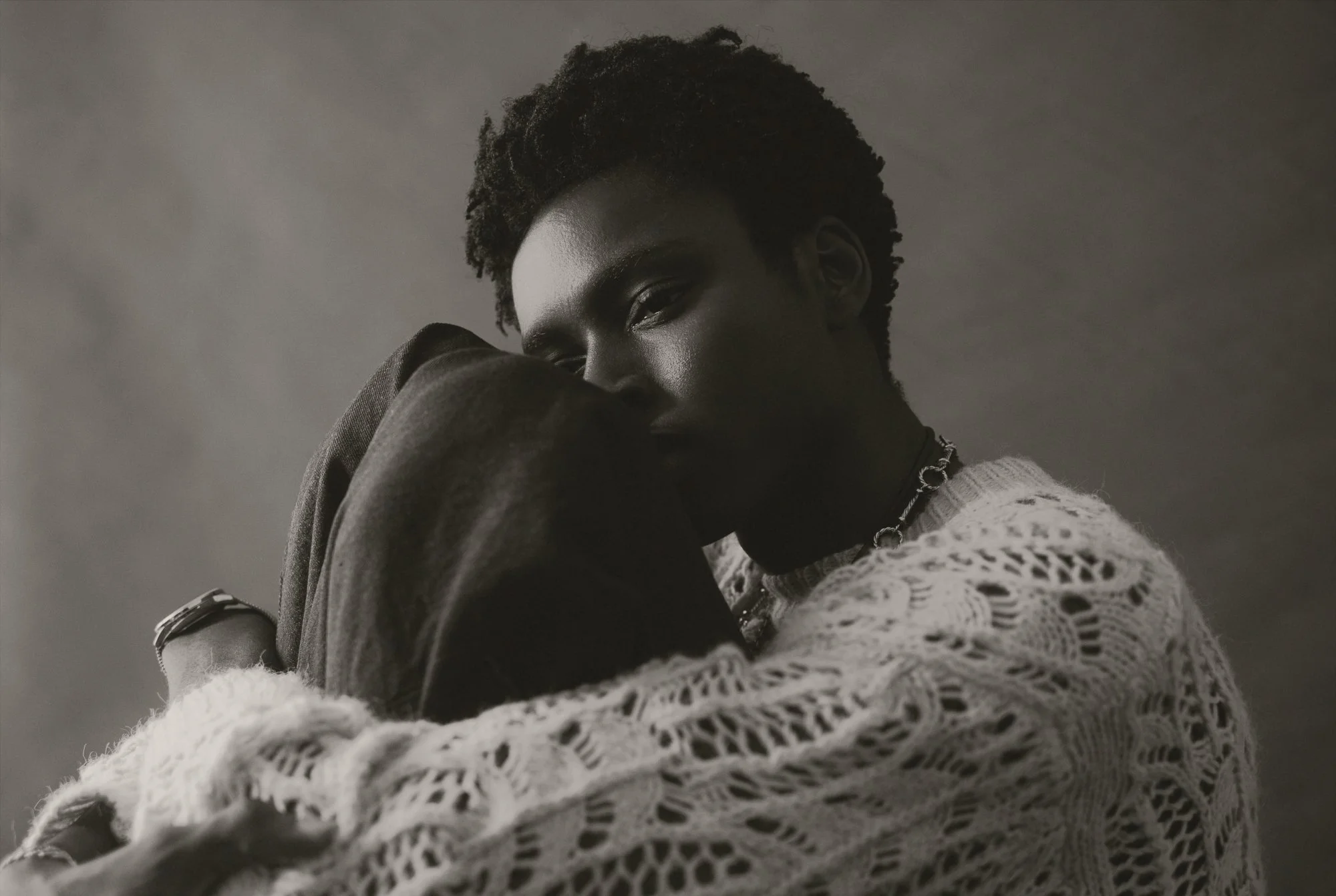
Ekene’s latest project is a love letter to childlike wonder
It’s been a year since Ekene made his debut on Mother Africa, carving out his place on the Lagos-based record label and cultural imprint. And now he’s layed out the experiences that have shaped him on his debut EP ‘Little Us’. This whimsical seven-song collection tells of the church pews, the university hostels, the friendships and the heartbreaks that have shaped the man he is becoming. Sonically, he moves through introspective blends of R&B, neo-soul and gospel, with each song leaving you like a conversation you didn't know you needed to have with yourself. At least that’s how this writer felt. The project also threads the lush harmonies and honest lyricism we heard on his previous offerings ‘Lullaby’ and ‘Red Benz’ into something more expansive and considered.
Connecting with him for this conversation wasn’t the first time. We had crossed paths at industry events. Then in 2025, we met again at our university campus – the same grounds that inspired songs like ‘Four Square’. It was the night we both finished our final exam and I saw a gleeful-looking Ekene at the science faculty hall cutting through the crowd and running over to say hi. This time, Ekene is an effervescent figure on my laptop screen, perched against a white wall somewhere in Lagos, while I'm nested in an apartment on a hill in Ibadan. We share a laugh about the fortuity of our meetings as we settle into the conversation. These serendipitous moments are exactly the kind of thing that ‘Little Us’ was built to hold: small, specific, but human. The kind of thing you almost miss, and then can't stop thinking about.
Lawale: You were raised in Lagos. What was that like for you?
Ekene: I grew up pretty privileged for the most part – private school, driver dropping me to and from. My life was school, church, home, family. What Lagos did give me, though, was the ability to meet people from completely different walks of life. Progressing to university was a shock. That was the first time I'd lived anywhere that resembled a boarding house. I cannot lie – I cried. My dad came to see the place, looked at it, and said, "It'll help you build character." I was really just having to tough it out.
Lawale: When was the first time you felt like you were making music that was actually yours, rather than something you were just a part of?
Ekene: Honestly, it was the first time I posted online — that was around 2019. People were like, "I really like this song. I relate to this." And I just continued from there. That moment made me feel like there was a space in music I could create for myself. It felt like I gave myself permission to start exploring music on my own terms. From then it snowballed and I became consumed with music.
“You start with deep introspection, you move through love, and you come out the other side with a clearer sense of who you are"
Lawale: How have your formative experiences fed into how you write and perform today?
Ekene: In terms of performing live, Lagos teaches you to hold your own very quickly. The crowd here needs a bit more ginger than most places so I developed confidence early on. In the writing, the stories are telling of where I came from. I write about the typical young Nigerian experience. The sound may not be the most Afrocentric, but the elements of where I grew up shine through in the storytelling.
Lawale: Have you ever struggled with self-expression as an individual or as an artist?
Ekene: I’ve felt pushback at certain points but not to the point where I ever felt like who I was is unnatural. I've always been very stubborn about being comfortable with myself. And I'm not going to switch up just because something about me makes people feel weird. The support I've had early on really reinforced that. Out of almost three or four years, I can count maybe two negative comments. And on the flip side, I've had people message me saying they feel more confident expressing themselves because they see someone doing the same thing.
Lawale: Let's get into ‘Little Us’. Your debut EP has been described as a love letter to childlike wonder. What does that phrase mean to you?
Ekene: "Little" doesn't necessarily mean the younger version of me per se but it does translate to giving myself permission to explore the vulnerable version of myself. So, it's really me telling myself: hey, it's okay. You can figure things out. Without shame, without holding back. That's the best way I can explain it.
Lawale: Can you walk me through the emotional arc of the EP?
Ekene: It starts with ‘Lullaby’ – a story that isn't even entirely my own, but it leads into everything else. It ends with a song that really summarises me coming into myself — realising that a lot of the ideas I thought were mine weren't actually mine. And then in between, love sits right in the middle, which felt like the perfect transitional space. You start heavy with deep introspection, you move through love, and you come out the other side with a clearer sense of who you are. But honestly, most of the time you don't know you're making an EP while you're writing the songs. They just come. And then you start to notice a trend, and that's when you collect everything and realise, oh, this is a body of work.
Lawale: Listening to the project, I could visualise so many specific stories being told. Can you describe some?
Ekene: I was walking on the road one day and I saw this nice car with a very nostalgic feel. I filmed it and started daydreaming. What if this car was my car? What if I was carrying my girl around in this car at university? So, I decided to write a song exploring all the experiences you'd have. Skipping class and taking drives, rolling the windows down through campus, listening to music, making out in the back. But underneath all of that, something went wrong. You're no longer together. And now every time you get in that car, there are just waves of emotion hitting you. That's ‘Red Benz’.
On ‘Four Square’, the reference describes the four-square feet of my room in the hostel at Ja. So, the song is about growing up in that godforsaken hostel, and one of those experiences that stuck out was how often I'd find myself in the middle of arguments about religion. Every morning, every night, somebody's playing a sermon, then someone else disagrees with what the pastor said, and suddenly the whole room is in an uproar.
Lawale: You're managed by Wale Davies and Kashope Owoaje. The nature of that relationship feels personal and intentional. How did that all come about?
Ekene: It started with someone blasting my page. Shout out to Fay. She sent it to a bunch of people, and Wale was one of them. He hit me up and wanted to meet. I told my parents; they were convinced I was being kidnapped but I went anyway. That was probably 2020. We met at Domino's. People were looking at him when he walked in but I genuinely didn't know who he was at that time. He set up one of my early studio sessions with Icon at the Red Room in Parkview. From there he was connecting me with people, putting me in the right rooms. Then we had a conversation about bringing on a second manager and that's when Kashope came into my life. We understood each other immediately. It's been development from then. Shows that resonate with my sound, producers and artists who resonate with me. I couldn't ask for better people.
Lawale: You've spoken about wanting your music to foster human connection and leave a legacy. At 24, that's a long view. What does legacy mean to you right now versus how you might define it 20 years from now?
Ekene: I define it by asking myself: if I were to leave this world, what would make me feel the most content? And I think it's this – that people who listen to my music find it easier to look back at the hardest parts of their lives, or the hardest parts of themselves. The memories that give them anxiety. The past that negatively shapes the relationships they make going forward. I hope that somewhere down the line someone can say, "The day I found this song, or this EP, it made thinking about that moment easier." That would be a legacy worth leaving.
Lawale: What do you want listeners to feel at the end of a ‘Little Us’ listening experience?
Ekene: I want them to be able to sit with hard or sensitive moments in their lives and feel comfortable — or at the very least, feel willing — to actually go through it. Those moments we keep tucked away in the back of our minds that we try not to think about. I want the music to give you permission to sit in it, to visit it, maybe for the first time since whatever caused those feelings to happened. Some kind of emotional closeness to your past self. That's what I want.