
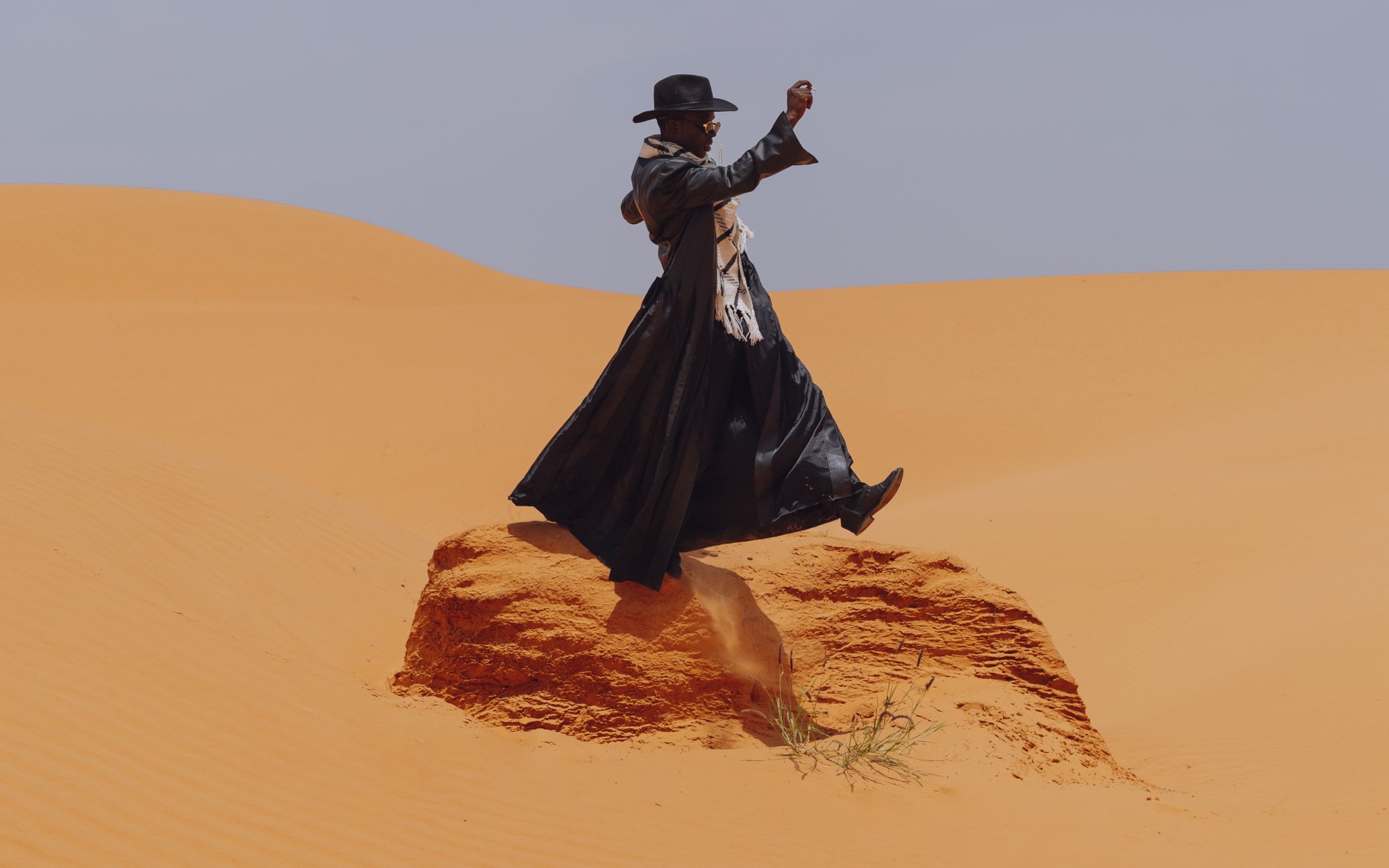
The Arewa boy who wants to take the Kalangu sound to the Grammy stage
“Ya ne?” (How are you?) I ask Firstklaz, the artist who has planted the Kalangu flag on afro pop soil. Pleased to hear his Hausa mother tongue leap out the mouth of a Lagosian, he replies with a smile shy of itself, “Lafiya lau. Yaya aiki?” (I’m well. How’s work?). And as our conversation begins to roll with ease, it transpires that this Nassarawa indigene went to university in Minna, Niger state, where I was raised. On every side, he is truly fortified by his northernism, so it is in tandem that he is fast becoming the messiah of Northern Nigerian music. But it wasn’t always like this.
The Abuja-born artist grew up in the church choir while listening to his dad’s R&B, rock and reggae favourites at home. “He was a fan of Freddie Mercury and Angelique Kidjo. He played Bob Marley all the time and I honestly don't think there was a single Michael Jackson CD we didn't own,” Firstklaz recalls fondly. These influences naturally slithered their way into his own music-making. Then in 2021, he began to culturally study these early influences and had an epiphany. “Bob Marley’s music is rooted in Jamaican culture and speaks to the realities of his people… I’m not from this place, so why am I making music like I am?,” he asked himself. “The best music sounds like where you're from. So, I should be making music that reflects who I am.”
After the transfiguration, he began entering the studio hoping to make something that had his DNA pulsating through the rhythm. And after much fiddling and toying, his lightbulb moment came with ‘Gen Z Anthem’, its Kalangu intro sounding so unbridled and at home on the track. “We just felt like it was really special. Even in the studio, we couldn't stop dancing and singing along to it. Then, when people embraced it the way they did, it just validated what we'd felt from the beginning,” he reminisces, glee spread across his face.
“The best music sounds like where you're from"
From this point on, the uniqueness of his sound has stemmed from a carefully balanced blend. Yes, the thesis of his music is built on the Kalangu but if you listen closer, you can still hear the silky soulful tone of an R&B singer. And this has reframed how he treats the Kalangu. To the artist, the sound can stretch to fit in fuji, like on ‘Gen Z Fuji II’, or afro house as heard on his latest cut, ‘Tsammani’. Many claim to be masters of Afro fusion but only few has perfected it like Firstklaz.
First and fore-most though, the artist is unabashedly Northern-Nigerian in an industry that has long been dominated by south-westerners. The nature of this set up means outliers are advised to straighten up. “I had people telling me to make my sound more afrobeats,” he affirms. “But I feel like I'm the owner of my vision. And when I'm really sure about something, I trust my instincts.” It is this confidence that allows him ignore stereotypical thinking about Northern Nigeria that pegs it as a region ravaged by insurgency, illiteracy and poverty. Therefore, nothing tangible can be birthed there. Firstklaz recalls a recent experience of this myopic view when he arrived for a show and a music exec commented “The aboki don come” [‘aboki’ used as a derogatory slur]. Instinctively, Firstklaz put him in his place. “Where I'm from, we're taught to respect people and their culture. So, I won't let anyone disrespect mine either. People don't always understand what it takes to do what I do, so I won't compromise on that.”
It's for this reason that he sees his music as a tool for challenging the pigeon holes Northern Nigerians are put in. He would never call himself a spokesperson for the region but he feels a responsibility to represent it accurately. He also has big dreams for the Kalangu sound to someday hear it on the Superbowl and Grammy stage. But his deepest desire is for more Northern Nigerian artists to break through. He sums up this benchmark in two hausa words “Mun zo” (We have arrived). He wants people to look, take stock and say truly “Sun (they) zo.”