
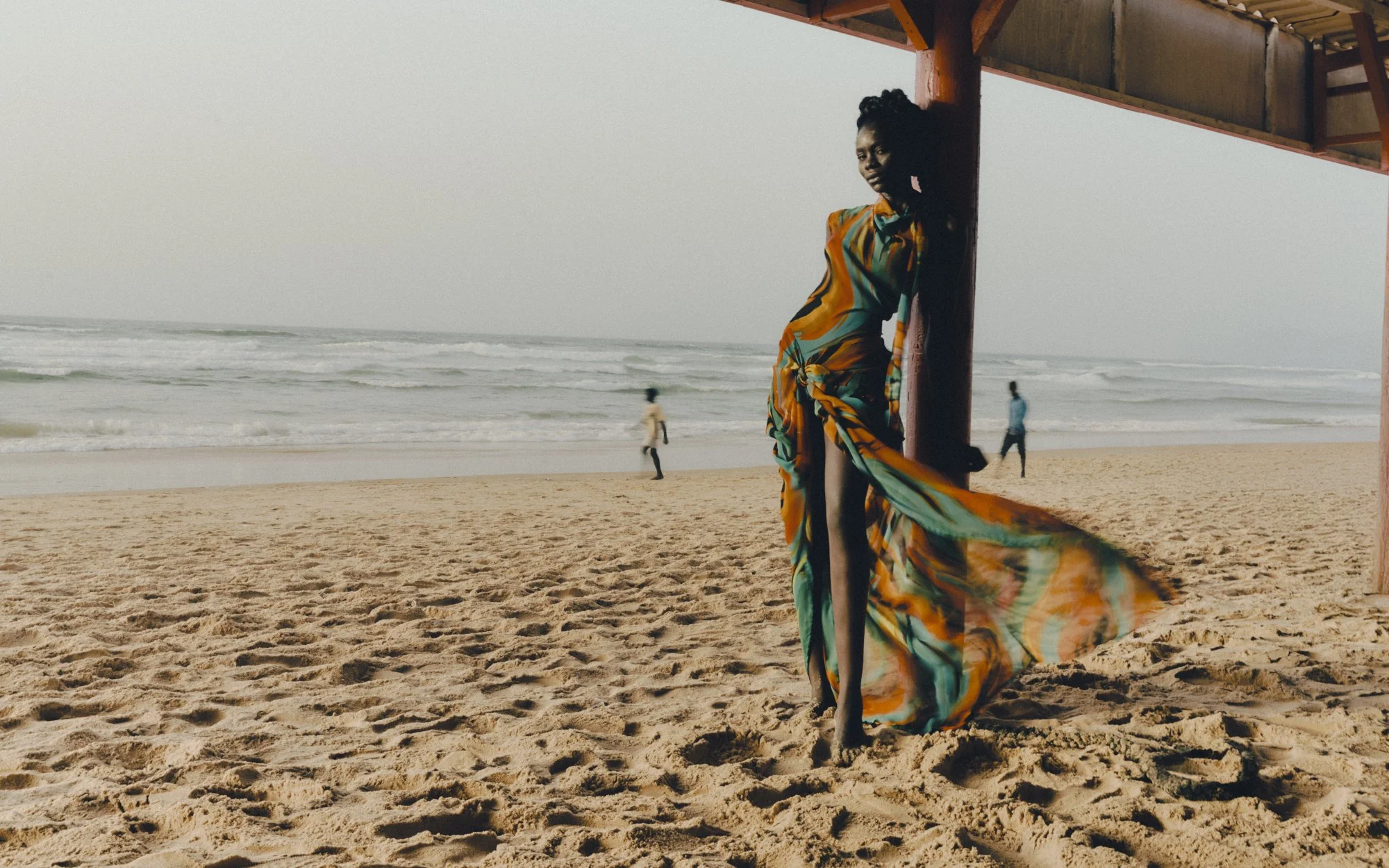
Creative director and founder Sarah Diouf celebrates a decade of Tongoro with a NATAAL exclusive
*Water waves sound*
The children gather around… and play. Circling her… intrigued by her
meditative state
‘What are you? Why are your eyes closed?’
— To dream.
‘What are you dreaming about?’ — the young boy asked.
— My home.
‘I want to see it too.’
— It is too dark for children, too deep for humans….’
— Then how can you see?
I don’t need to. I already do.
“I’m not a designer but I know how to build a brand.” This is what Sarah Diouf told me back in 2016, at the dawn of Tongoro. Her words caused a bit of a stir, as Diouf dared to step out of her lane as editor of Ghuber magazine to launch a brand steeped in the ethos of ‘Made In Africa’. Her goal? To establish an elevated yet tangible womenswear line with its heart and feet on the continent that could be worn and understood globally. The results, 10 years down the line and against all the odds, speak volumes. Tongoro has shown everywhere from Lagos to Cape Town, been worn by Naomi Campbell and Alicia Keys, and exhibited at the Brooklyn Museum. Diouf has collaborated with Cartier and Vlisco, spoken at the United Nations and established a production hub in Dakar, from where she recently stepped it all up with Tongoro Couture. And then there’s Mrs Carter, who she can count as one of her biggest advocates.
So, is she a designer now? That’s not even half of it. Creative director, photographer, filmmaker, storyteller, entrepreneur – take your pick. This unstoppable force has put all that she is into Tongoro. And through it, she has found her truest purpose.
It feels only right, then, to come back together once more to exclusively reveal the extraordinary anniversary story, ‘Jigéénu géej: The woman of the sea’, and sit down with Diouf to reflect on a decade of dedication to Africa’s creative ascension. On our video call, she’s snuggled on her sofa, her hair wrapped, her face clean. “Social media might make it look like I’m living my best life but you should see my day-to-day,” she laughs modestly as we settle in. Here, in her own words, is what you need to know about her next chapter.
I began Tongoro to bring people together.
For the longest time, Africa was a well of culture that the world hadn’t tapped into. And from a personal perspective, having grown up in Abidjan with parents of Senegalese, Congolese and Central African descent, who had been forced to relocate to Paris in 2000 because of a coup, I wanted to build a concept that people could see themselves in. African fashion is celebratory and tailoring culture is everywhere – it’s a language we all share – so that’s where the tagline Made in Africa came from. I also saw that while African fashion was having a new dawn and designers were changing the game, their work was hard to get hold of. So, if I was to build a brand that could support my future, it would have to be accessible and affordable. That’s how Tongoro came to life.
My vision was to become one of the leading fashion brands on the African continent, and that’s what I’ve achieved.
Success isn’t about validation from the West. It’s about establishing a foundation that works. I think in terms of systems – pace, production, capacity, human resources, training – solidifying the ground so that we can scale while preserving the essence of the brand. I remember about five years in, the tailor who has been with me from the beginning told me that he’d been able to buy a house in his village for his mother, and he was now at peace. And I just burst into tears because it drove home that I’m doing something that impacts lives here in Dakar. And that’s beautiful.
The next 10 years is about proving that Made in Africa is valuable.
Today Tongoro is a 15-strong team and the business is in a stable flow state. That gives me room to reflect. I’ve poured my energy and creativity into it but now I want the brand to be bigger than me. In the coming months I’ll be doing pop-ups in different cities to connect to our community and I want to have a retail presence in as many African countries as possible. I’m also thinking about how we can build an industry that is based on culture, that is sustainable, and still compete on a global scale. Let’s create brands from the continent that take over the world.
I launched Tongoro Couture to challenge the concept of luxury.
When we think of luxury, the first place that should spring to mind is Africa because it’s where you can have a bespoke experience for just about everything – and that’s priceless. So, the value that we give to the petite mains at Chanel or the ateliers of Hermès, should be given to our tailors and artisans too. Their skills are passed from generation to generation, which is honourable and must be recognised.
Each Tongoro Couture design is inspired by my environment in Senegal and translates into movement. Take for example our Petaw jumpsuit. It’s a very really voluminous silhouette covered in gold cowrie shells, which takes two weeks to make to a client’s measurements. And when someone walks into a room wearing it, it just screams ‘I’m here’. In that way it speaks to West African aesthetics. Living here reminds you to dress like every day is a special occasion.
Working with Beyoncé was something I dreamt of from the very beginning and so far she’s worn Tongoro nine times.
She is a very loyal person so once your work resonates with her, she likes to grow with you. Creating a look for the Renaissance tour became the most challenging and rewarding project I’ve ever known. I’m a perfectionist but the execution and discipline required to align myself with her level of excellence really was an out of body experience. It was a six-month process during which we remade the bodysuit five times to take in evolving factors of the performance. And when we reached the fourth iteration, it was good enough but I knew it could be better, so we made it again.
I lost my grandmother in the midst of it all as well. So, it demanded a version of myself that I hadn’t met before. But looking back, it was so inspiring. Now I know that her recognition has forced me to step into my authority and take ownership of calling myself a designer without fear. It’s a validation of ‘Made in Africa’ of the highest order. And for the business, it has opened doors. So, if you’re reading this Beyoncé, thank you.
For the next 10 years, I’m no longer manifesting – I’m womanifesting. I want peace and balance.
Last December I almost burnt out. So now I’m giving myself the permission to rest, reflect, and get back to the creative essence of Tongoro. Because if I’m depleted, I can’t infuse all the gifts that I have into the brand. And the next 10 years are going to require more from me than ever before. I have to be prepared for what’s to come, and that’ll involve pure storytelling that really transports people.
My friend has found a new title for me. She said, ‘You’re not just a designer any more. You’re going to be a cultural industrialist.” And I was like, yes, that’s it.
Visit Tongoro
Photography Aart Verrips
Styling Sarah Diouf
Beauty Gaby Ayimele
Model Maguy
Words Helen Jennings
Published on 10/06/2026