
Getting under the skin of Tolulope Oye’s latest campaign and family archives
Tolulope Oye approaches fashion through memory, both personal and collective. As the founder of Meji Meji, her focus is on translating her family’s history and the everyday hustle of Lagos life into wearable pieces that illicit knowing smiles across the diaspora. And with her AW26 collection, both her designs and the short film ‘The Past That Never Fades’ take us on a nostalgic journey through Nigeria, past and present.
The starting point of Meji Meji traces all way the back to a Columbus hair salon. It’s where an early understanding of beauty took shape through routine and repetition. “Every day after school, I would go to the salon where my mom worked, and the first thing that was always on TV was a Nollywood movie,” Oye recalls. The environment combined two forms of storytelling at once: what was happening on screen and what was unfolding in real time. “That was a big part of my experience growing up.”
“I love when women see each other and say, ‘You’re my Meji for the day.’”
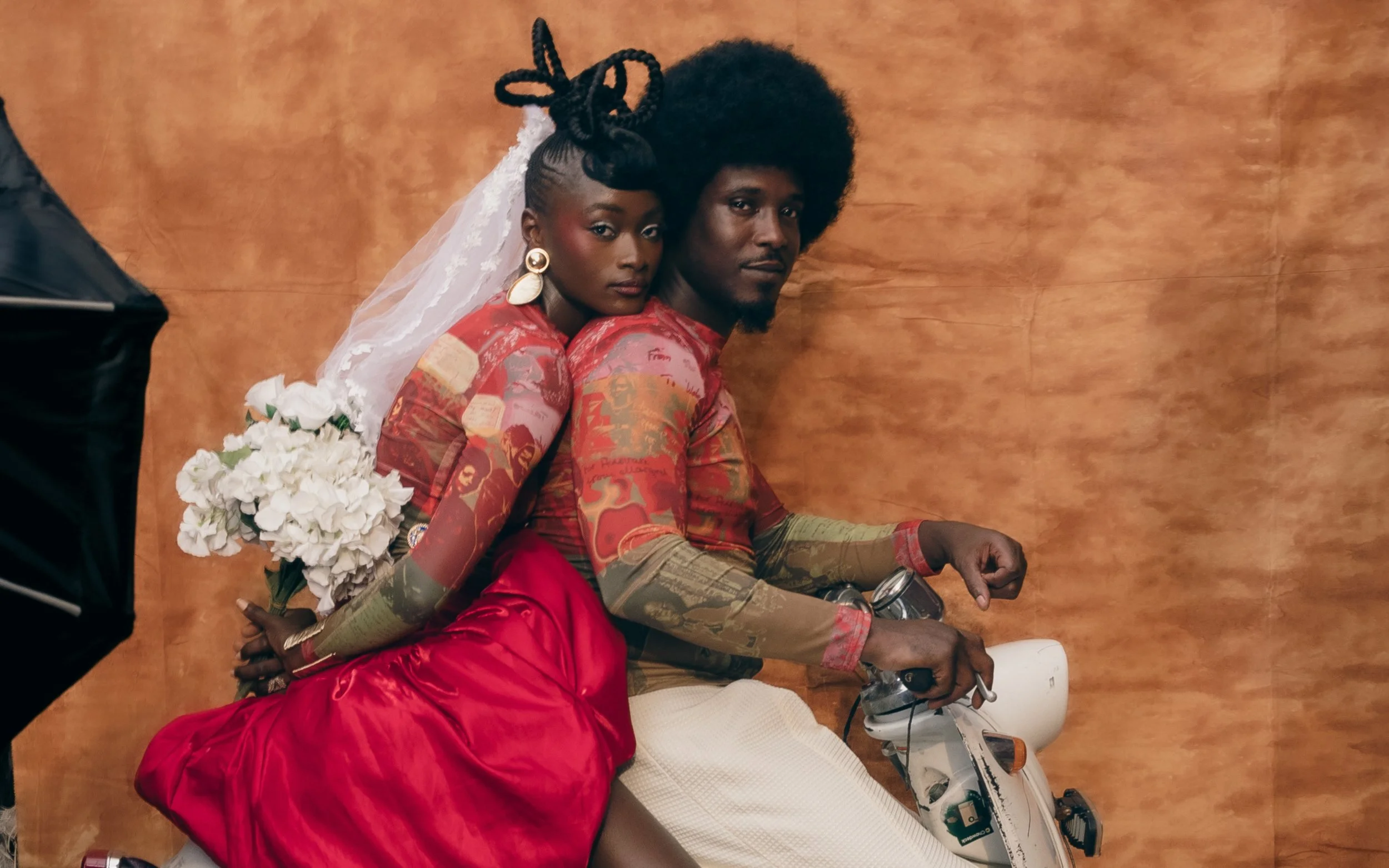
Fast forward to 2019, Oye visited her grandmother in Agege and discovered a bundle of family photos, postcards, certificates and letters from the 1950-70s. “There were conversations, love letters… it was nice to see how things travelled during that time,” she recalls. Oye scanned and stored this treasure trove, going on to move back to Nigeria and launch Meji Meji, which is named after the street her grandmother lived, Ore Meji. And now is the moment that this archive finally comes back to life. The Family Album mesh top is built from these photos while in the film, a motherly figure flicks through her sepia-tinted snaps as she remembers how she met her man.
The idea of preservation carries on throughout the collection. The Color Riot T-shirt draws from the colour palette of OMO packaging referencing laundry days and domestic routines. The same visual language appears in the film through a scene of washing clothes outdoors. “We like to have little nuances,” Oye notes. “If you know, you know.”
Alongside this, the ‘go-slow’ of Lagos’s congested road network is felt through a collaboration with lens artist Chukwuka Nwobi for the Danfo skirt and hat. These incorporate imagery from the city’s buses and the phrases commonly painted on them such as ‘No food for lazy man’ and ‘Balance’. “Even traffic, I don’t really see it as a burden anymore. I look at it as a source of inspiration,” Oye reflects.
Kinship also sits at the centre of the season’s storytelling, particularly the idea of sisterhood. ‘Meji’ comes from the Yoruba word for “two” and in the collection we can enjoy the duality of the Soul Sister tracksuit. “It’s nice to be able to share similar experiences and stories,” Oye says, herself an older sister. “I love when women see each other and say, ‘You’re my Meji for the day.’”
Within the broader conversation around the increasing global attention to Nigerian fashion, the designer takes a measured position. “A lot of the time people think African fashion has to look a certain way, so one thing that’s important to us is to change the narrative,” she says of her relatable designs. A background that moves between Nigeria and the United States continues to shape how her ideas are expressed. “I’m able to convey African stories but still have a Western perspective grounded in a Nigerian lens.”
The collection ultimately returns to something simple, which is honouring heirlooms by creating them anew. As the BTS video reveals – here debuted by NATAAL – it takes the proverbial village to move culture forward. And that’s something Meji Meji never stops doing. At a brand pop-up in December, visitors were invited to submit personal photographs to be compiled into albums. “I want people to get back to the basics – printing pictures and going through memory on a page,” Oye says. “Every journey is a story, and it should be documented well.”