
ART X Lagos 2026 honours Nigeria’s modernist heroes while asking what lies ahead for contemporary practice
Before Nigerian modernism, the country’s artistic practice was rooted in complex indigenous knowledge and materials. Across the region, artisans worked with clay, wood, bronze, textiles, drawing and other communally developed visual forms. Colonial art education subsequently introduced standards that defined fine art. By the middle of the 20th century, however, young Nigerian artists began negotiating a possible distinct practice. More than 60 years later, these questions remain relevant.
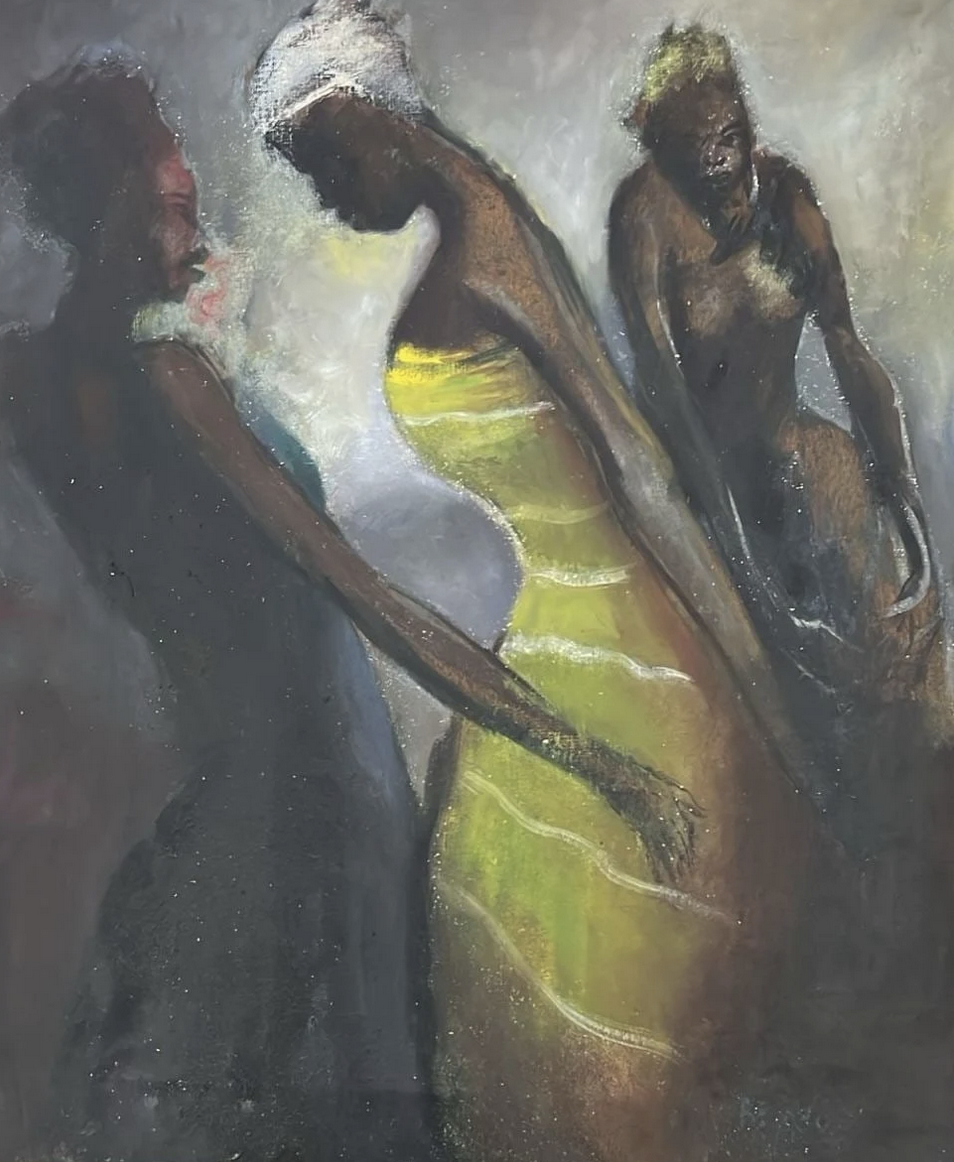
Ben Enwonwu, Dance of The River (YOWUBA) 1980, Kó
As ART X Lagos begins its 11th edition, the fair returns to the artists, architects, educators and thinkers who shaped Nigerian modernism, asking what their experiments might mean for contemporary art. Running from 5 to 8 November at the Federal Palace in Lagos, this year's edition takes the theme A New Chapter, A New Decade. For founder and director Tokini Peterside-Schwebig, the return to this history is far from nostalgic. She describes the modernist generation as one that understood that “looking to our past does not mean standing still”. Their ability to draw on inherited knowledge and transform it into new forms, she suggests, offers a way of imagining the future.
“Looking to our past does not mean standing still"
Tokini Peterside-Schwebig
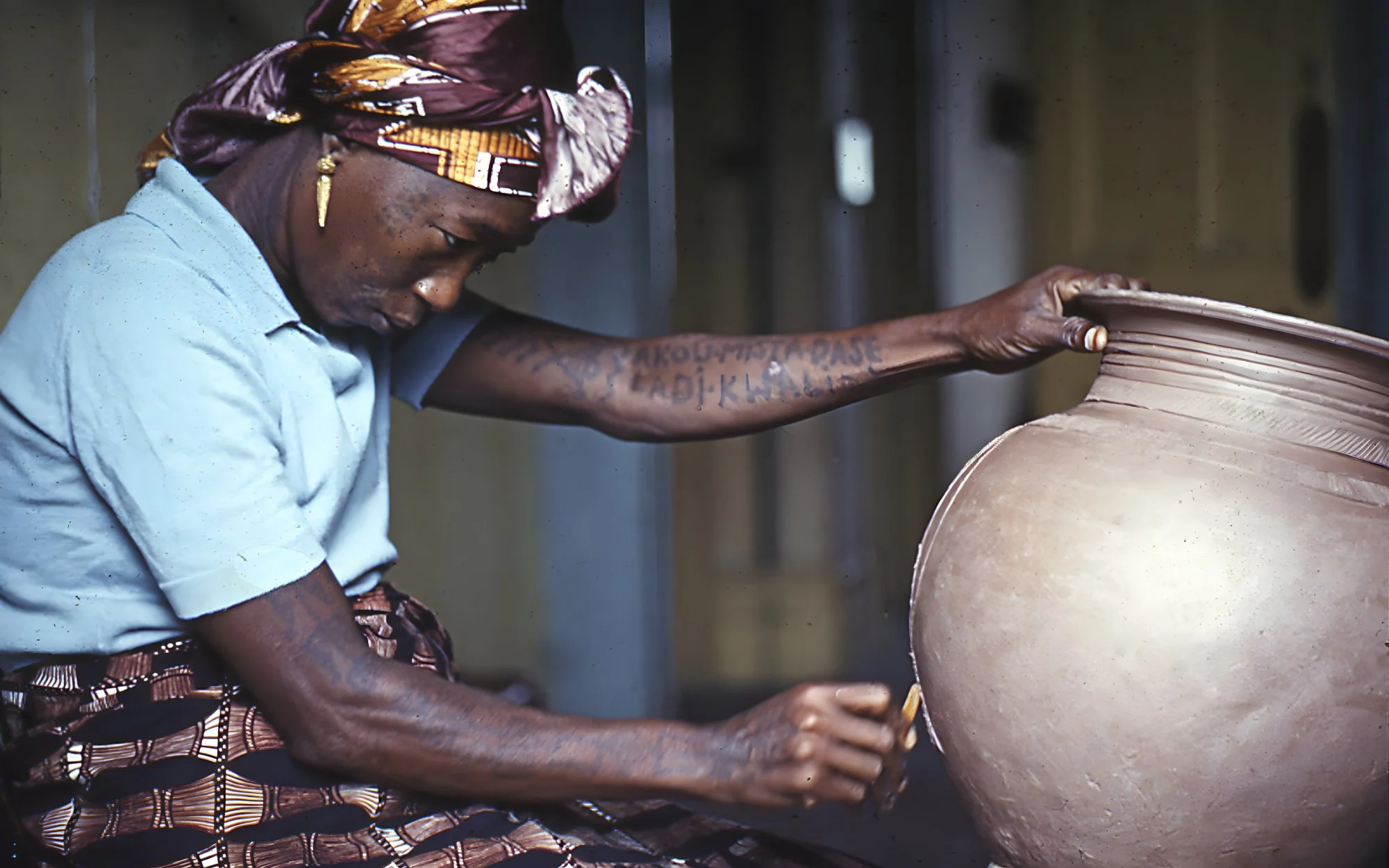
At the centre of this historical return is ART X ICON: Ladi Kwali: Beyond the Vessel, developed by curator and researcher Dr Jareh Das. Born in the village of Kwali in present-day Abuja, she learnt pottery from her aunt, mastering hand-building and coiling techniques within Gbari matrilineal traditions. In 1954, she joined the Abuja Pottery Training Centre, where she encountered wheel-throwing, glazing and high-temperature firing. These methods complemented her native knowledge, and Kwali continued to develop her hand-built forms while engaging with new techniques and networks. Her work travelled internationally, challenging how people understood pottery. Other female potters, including Kande Ushafa and Asibi Ido, alongside pottery traditions from Gbari, Nupe and Bida communities, are also being presented in Beyond the Vessel, broadening the story from an individual biography to a shared making history.
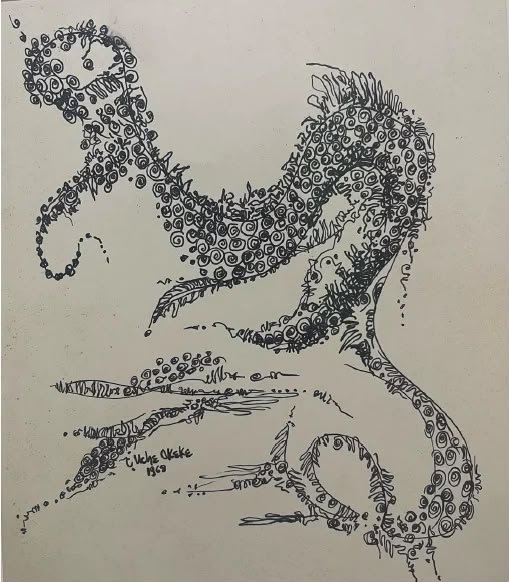
Uche Okeke, Primeval Forest (1968) Adegbola Gallery
Alongside this, ART X presents the work of other Nigerian modernists including Ben Enwonwu, Uche Okeke and Bruce Onobrakpeya. Okeke and Onobrakpeya were central figures in the Zaria Art Society, whose philosophy of Natural Synthesis sought to bring indigenous artistic traditions into dialogue with modern artistic expression. Rather than imitating European standards, artists associated with this movement asked how African visual cultures could provide the foundations for new contemporary art forms. To Okeke, synthesis meant looking at uli, the linear drawing tradition of Igbo women. His Primeval Forest (1968), presented by Adegbola Gallery, is a striking example of his engagement with uli. Nigerian modernism, in this sense, is an ongoing process between inherited forms, changing social realities and the desire to imagine.
The contemporary artists presenting at ART X Lagos this year extend these conversations in different directions, exploring the possibilities of African art through their engagements with contemporary experiences.
Ozioma Onuzulike (Kó)
A professor of Ceramic Art and African Art History at the University of Nigeria, Nsukka, where he directs the Institute of African Studies, Ozioma Onuzulike's practice combines material experimentation with historical research. The Nigerian ceramic artist, poet and art historian works with clay, ceramic beads, palm kernels and other materials, often turning familiar natural resources into complex sculptural forms.
His palm-kernel shell bead works are a profound example. In a statement published by Ceramics Now, Onuzulike explains his interest in palm kernels past their aesthetic qualities. He describes the palm kernel and its shell as “historically charged", referencing the palm oil trade between Africa and the Western world after the transatlantic slave trade. He transforms these shells into terracotta forms and glass beads through an intensive studio process, subsequently weaving them into mixed-media ceramic structures.
Djakou Kassi Nathalie (Alexis Galleries)
Cameroonian-born, Nigeria-based ceramic artist Djakou Kassi Nathalie’s work has always involved challenging the limits placed on the medium. In a conversation with the Can Art Save Us? podcast, Nathalie recalls difficulties as a ceramics student in his native country. People questioned why she had chosen to study pottery, but she became determined to show the medium was more than what it was commonly assumed it to be. She describes clay as an unusually responsive material: “the clay obeys”, allowing her to manipulate its shape, surface and volume.
Her work also documents social experiences. In an interview with Iband, she describes her practice as a form of documentation, addressing subjects including domestic violence, child abuse, migration and social unrest. She considers ceramics a medium capable of preserving these experiences, challenging the assumption that its fragility makes it less durable. “Ceramics can outlive generations,” she says. Nathalie’s practice therefore considers what the medium can preserve and communicate.
Pelumi Ponmile (Affinity Gallery)
In an artist statement, Nigerian contemporary artist Pelumi Ponmile describes his practice thus: “I transform discarded materials, especially aso-òkè, into collage artworks that explore African identity, resilience, and cultural memory. Through texture and symbolism, my work reimagines waste as beauty while celebrating tradition, sustainability, and hope.” At a time when sustainability is increasingly discussed within the creative industries, Ponmile’s work presents a material approach to the subject. He introduces themes of reuse, waste and the afterlife of materials by working with textile fragments instead of newly produced cloth. The fabric's previous existence remains present even as it becomes part of something new.
Priscilla Kennedy (Gallery 1957)
Ghanaian artist Priscilla Kennedy typically explores the female body through her country’s textile traditions. Working with kente, velvet, beads, sequins and embroidery, she constructs images in which the body appears less as a stable figure than as something fluid and layered. In a conversation with STIR, Kennedy describes her relationship with fabric using a childhood memory. Her mother would buy different pieces of cloth around the births of her children, each fabric marking a moment in time and celebrating their arrival into the world. This personal archive became her way of thinking about textiles while working with fabrics from local markets, considering their histories and the labour embedded in their production.
Ngozi Omeje-Ezema (Kó)
Ngozi Omeje-Ezema is a Nigerian ceramic installation artist based in Nsukka, Nigeria. Her practice moves between pinching, tying, hanging and wrapping, using individual ceramic elements to construct larger installations. In an interview with Art Formes, Omeje-Ezema discusses the influence of El Anatsui, whose use of repeated elements helped her consider how individual units could be assembled into larger forms. She also identifies Cornelia Parker and Jaehyo Lee as important influences, particularly in their approaches to suspended sculptural installations.
Furthermore, Omeje-Ezema’s work draws on the Igwebuike concept associated with the Nsukka art school, which emphasises strength in collective unity. This idea is reflected in her use of multiple clay units, which come together to create forms that would not exist through any individual component alone. As she explains, working with suspended elements and motion presents different technical challenges, requiring experimentation and careful consideration of how individual pieces interact in space.
Omeje-Ezema’s ceramic practice makes her participation in this year’s ART X ICON Masterclass significant. The programme includes a documentary screening, an exhibition walkthrough, practice presentations and a masterclass session with Omeje-Ezema. Bringing 10 artists into dialogue with Kwali's legacy, the programme is designed to encourage critical thinking and new approaches across disciplines. Three participants will also receive grants of ₦1.5 million following the programme's final online presentation.
As an imperative, none of these exhibiting artists should be understood as following one continuous modernist tradition. Their practices point instead to the different ways knowledge is encountered and reproduced. As ART X Lagos enters a new decade, the question is simply what contemporary artists will do with what they have inherited and what institutions, and the larger art ecosystem will enable.
ART X Lagos runs from 5-8 November 2026 at Federal Palace, Lagos.