

nora chipaumire pays respect to the Shona creation story of gadzi for Tate Modern’s Infinities Commission 2026
We are surrounded by looming boulders with warm, smooth curves that beckon our touch – ancient formations dancing and yet still. We are bathed in a dim, golden light that seeps all around as water pools at our feet and a generative presence rises up above, out of sight. And we are blessed by sound. The low, low reverberations of revolution. At once stirring and healing, liberating and loving, the sound holds us close like a gentle hand on one’s chest. In this space we are free to sway or to cry. We are free to breathe and just be. And we are truly welcomed to ‘gadzi’ - nora chipaumire’s immersion into the creation story of gadziguru.
This powerful new installation is the fruits of the Infinities Commission 2026 – Tate Modern’s platform for experimental, cross-disciplinary works within the Tanks, curated by Valentine Umansky, Curator, International Art and Francis Hardy, Assistant Curator, International Art. Following the debut edition from Christelle Oyiri in 2025, Chipaumire’s internationally renowned practice makes her a natural choice for this second annual commission. The Zimbabwean artist works across movement, theatre, film, sound and sculpture to build provocations that refute boundaries put upon what it means to be African, Black, Woman. And over the past decade her works have increasingly centred on imagining beyond colonial histories of southern Africa by venerating the legends of the Shona people in the here and now.
Fresh from her studio residency at Savvy Contemporary in Berlin, and having recently shared her works ‘acontinua – an obituary, a manual for a life lived chasing LIFE’ at the Smithsonian, Washington DC and ‘DAMBUDZO’ at Tanztriennale 2026, Hamburg, this citizen of the world is ready to reveal her latest offering in London. On the eve of the opening, NATAAL sits down with Chipaumire to better understand the timeless female force of gadziguru. The artist talks with ardour, and laughs often, about the making of this sacred space and the spirit of chimurenga it evokes.
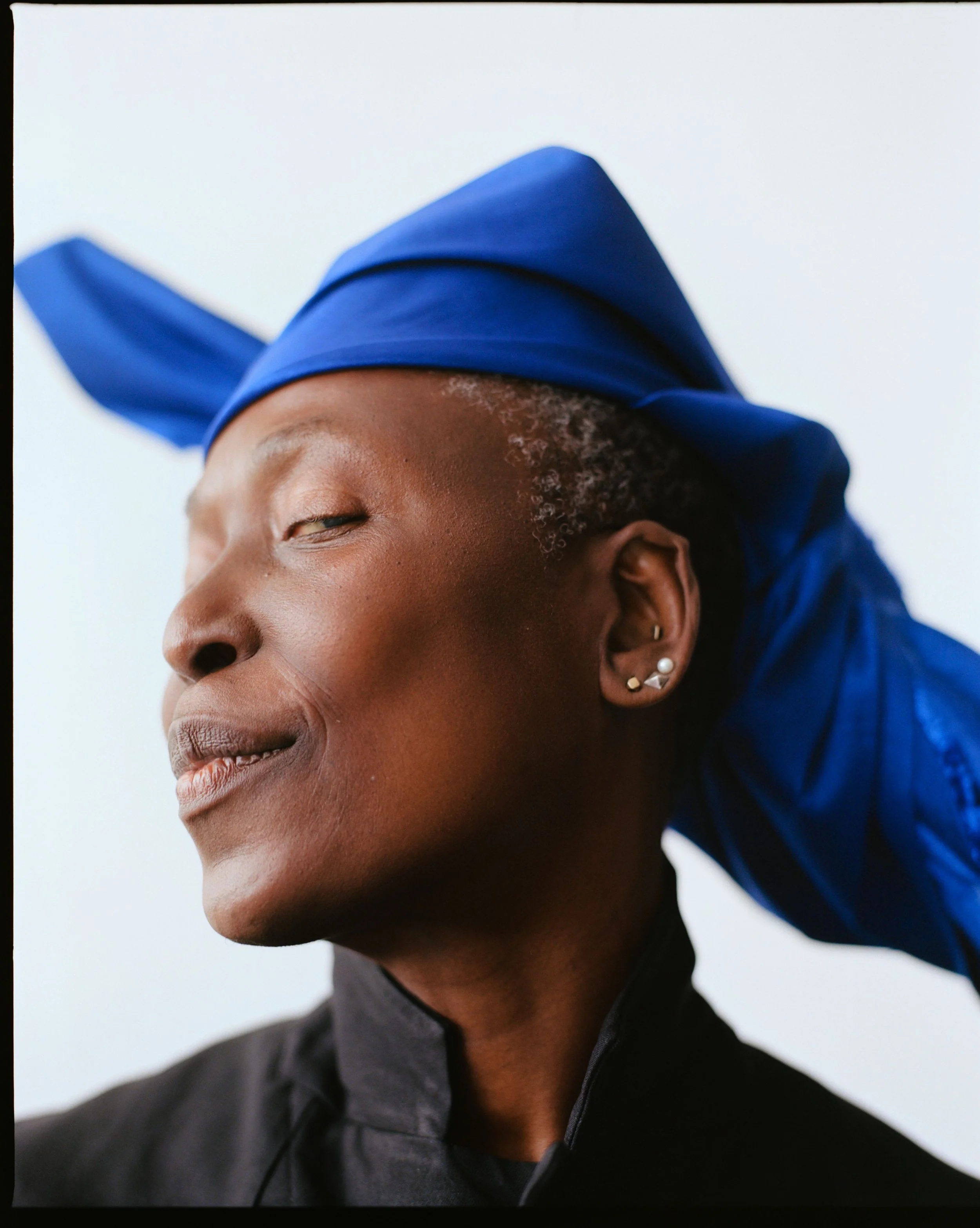
Portrait: nora chipaumire by Camila Falquez, 2025
Congratulations on the Infinities Commission 2026. What was your initial response when offered this platform?
Whenever I’ve come to the Tate over the past 30 years, I’ve thought that one day, I'll have a work here. Of course, that's what every artist hopes for. And when that call came, I was just gobsmacked. It was a mixture of fear and joy. But also, I'm 60 years old, and my team has done provocations all over the world, so we’re ready for this. And I believe that the work we’re showing here announces that.
What beliefs and energies have inspired the work and its invocation to gadziguru?
I'm a Zimbabwean, I’m African, therefore the Animist traditions are unashamedly part of that lived experience. And as I'm running towards God, as they say, I'm feeling an urgency to articulate those belief systems that have guided my people since before 1890, which is the watershed year when Cecil John Rhodes crossed the Limpopo. And then we had the 100 years of what I prefer to call the darkness. It’s important to me to go outside of the so-called recent written history, and invest in works that dig behind what we think we know about the Shona people.
So, this work is a celebration and acknowledgement of gadziguru – the ultimate creator. In the beginning there is water from which all life is brought forth. It is the element we all need and without it, we have nothing. For me and my fellow thinkers, it’s also a way to address questions about the Anthropocene, which is Global North-centred, while we have other ways to look at the climate and the responsibility that we all have for this planet. My people take a lot of care around water, and be doing so, we are taking care of gadziguru.
The work also honours Zimbabwe’s Balancing Rocks. Tell us more about their significance.
These granite rocks are very much a presence in my part of Zimbabwe and sit on top of each other, defying gravity. Scientists want to say its volcanic but we say gadziguru gave birth them as her children. These landscapes have taught me a great deal about abstraction, about sculpture, about density, about light, about warmth, you know? So, it’s way to talk about my own personal education, my ways of seeing and listening, and ways to talk about oneself. In a sense, this work is a very obtuse personal portrait.
How do these multiple ideas manifest in Tate Modern’s East Tank?
As you walk into the space, it feels like a stone cave and there’s that fragility of light that we encounter in these enclosed spaces. And the scale of the render is breath-taking, even though as humans we are not able to get to the power of the creator. In some aspects it reads as the real thing and then you turn around and can see that the hand-built structure is made from wood, paper and metal. There are also a series of sound systems that form a membrane of sound allowing god to speak through the rocks.

Installation view of Nora Chipaumire: Gadzi, Infinities Commission 2026, Tate Modern
How do you hope visitors will embrace this offering?
I’m hoping it will create a warmth, a generosity, a quietude, a slowing down. The public can just sit in there, even lie on the floor, and spend some time with the feeling of the room. They can even get up close and touch, as you would in nature. There won’t be any barriers typical of museum exhibitions.
They will also feel the work in the vibrations of sound. This is a physical experience felt through dub basslines.
Yes. Everyone and everything holds a particular frequency, that's what life is. Rocks, volcanos, mountains, that’s the bassline in nature – the solid rumble, you know. Here, the public will be able to drop into the cadence of this room and therefore be performing their own liveliness. We’re also inviting that low vibration through base culture. We thought it really appropriate for London as one of the epicentres of experimental electronic sound. But we're also talking about the specificity of Zimbabwe where we have the mbira, which through urbanisation has been transported into guitars. So, what we’ve created is this beautiful stew.
What shape will your planned performances take?
Our presence as a performing team is an augmentation on the room, rather than a thing onto itself. And that expansion is about the diversity of who we are as human organisms – the lions, the monkeys, the birds, the elands – we move as a totemic presence. gadziguru is ancestrally present as water while the performers carry aspects of animates. So, imagine what happens when we all gather in the Serengeti, for instance? When all those animals do their yearly crossing, it’s something to behold, and that’s how I think of our provocation – an ambulatory migration where everybody follows the leader. And then there's a tension that happens between being grounded and also in motion. I think those two axes will be in play.
“The public will be able to drop into the cadence of this space and therefore be performing their own liveliness"
What have you learned through the making this work?
Well, teamwork remains dream work. This has been a year-long process of putting together different teams in Berlin, in Harare, in New York, in London, so what has been underscored is the importance of being a good leader. The core team have all come to spend time in Harare – to know what the sun feels like on the skin, what it looks like on the rocks. Allowing for this kind of research investigation is critical. I don't think we could have arrived to where we are now without people putting their feet in the soil, smelling the air, and trying to create a common ground. We’ve landed on a process which I hope remains for the rest of my life.
As a movement artist, in what other ways do you nurture your team?
I'm determined to be non-aligned and work across cultures, so the longer we all work together, the better the alphabet we create, and the easier it is to deal with cultural differences.
Which is where your practice of nhaka comes in.
Yes. nhaka is a practice for the movers, the singers, the musicians and even the tech team, and it has become an essential way to discipline the body. We begin our day with a communal activity – breathing in a way that helps us understand if there's an issue, and find a quick resolve. We're all moving together in a certain way of displacing weight. It is a living practice so we're always inventing new vocabularies, new ways to shift. The ultimate goal is to create an intelligent organism that can respond to any kind of situation and also to grow old beautifully.
“I hope the work creates a warmth, a generosity, a quietude, a slowing down"
Going all the way back, how did you originally connect to your body as your artform?
I was born in 1965 in Rhodesia, so being an artist wasn’t something I had an idea of then. No one in my family was named such or did such. Independence in 1980 opened up some horizons but even then, the education system remained influenced by Oxford and Cambridge. I had good enough grades to get into law school and that's what I wanted to do because it was prestigious and it made my mother happy. I also had the burden of being the first person in my family to go to university.
But I always knew I had a creative bone. I had many interests – fashion, photography, cinema, acting, DJing. And discovering movement became a happy accident. I was a long-distance runner and tried a dance class as a way to stretch my body, and it turned out to be the Martha Graham technique. I quickly understood that I could be on to something as woman creating a business and as an African creating a practice that could support the body. And now I consider the experiences we construct – places of learning, places of advocating, places of showing a humanity – to be what I would have wanted to build as a lawyer.
No doubt you have made your mother proud in the end.
Part of what drives me to do my best is her. She was a child bride, and became a single mother [of four] and she always worked hard. So, I take what I do very seriously. Of course, we have lots of fun and we play hard but we work hard, too. And I believe that the rigour of research, of writing and of archiving is not less because we're using the body. In fact, it's more so. So that's something that I always give to my mother.
And ultimately, the work you have put into building at the Tate is honouring the mother, too.
Absolutely.
Public performances will be 7pm on 26 June and 3pm on 27 & 28 June 2026. Learn more here.
Visit nora chipaumire
Visit Tate
Words Helen Jennings
Video Tom Morsli
Published on 02/06/2026