
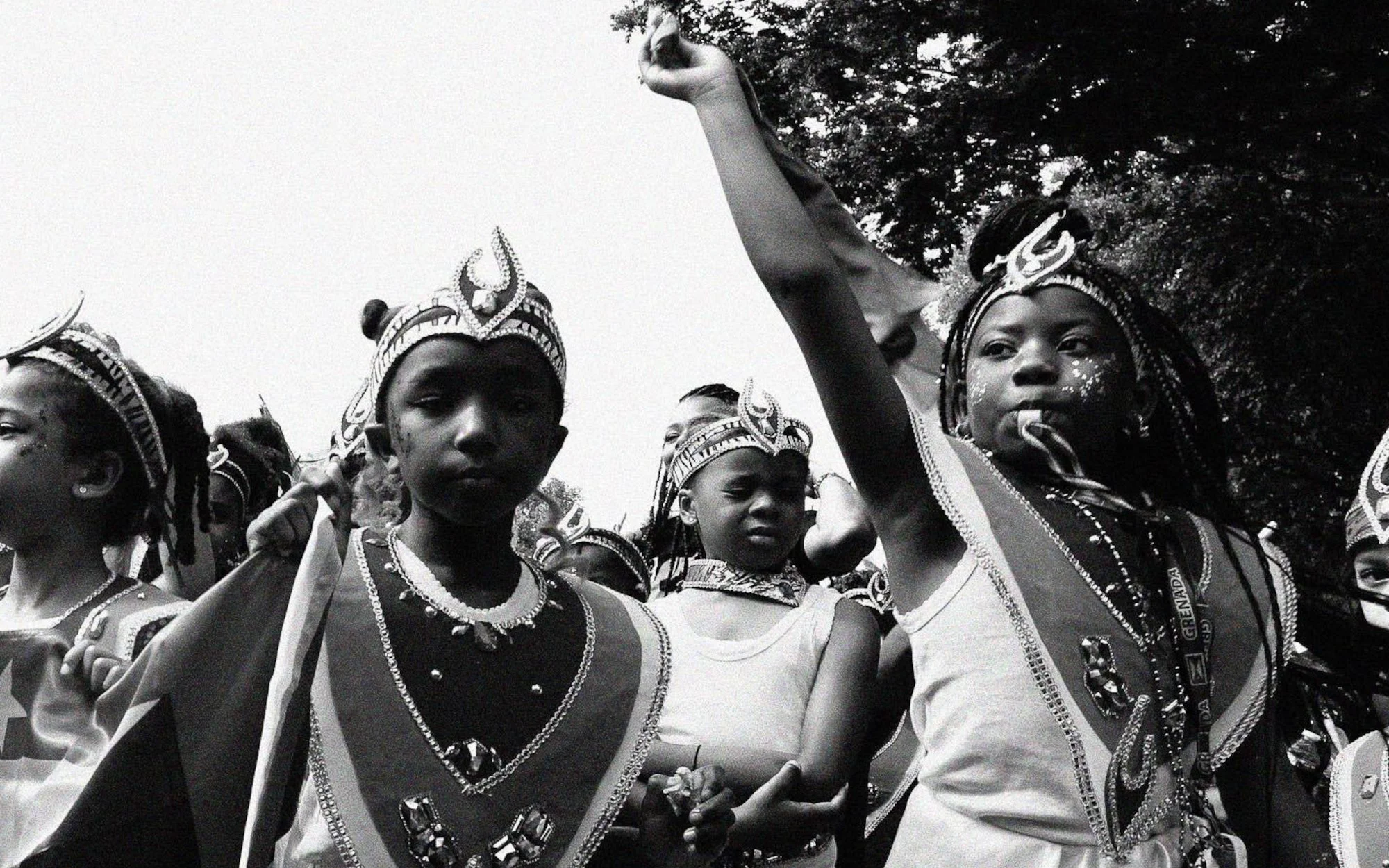
As media partner for The Legacy of Notting Hill Carnival, NATAAL meets the exhibition’s community of voices
One of Lydia Blaize’s earliest memories of Notting Hill Carnival was witnessing the procession go by from the window of her grandmother’s Ladbroke Grove home. “She is from Grenada and my parents are also both from the Caribbean, so watching the parade was always a family function,” Blaize says. As she got older, her relationship with Carnival progressed. First, she moved to the pavement with her aunties and uncles. Later, she participated in J'Ouvert (where people cover themselves in paint before sunrise on the day of the events) and dressed up to join the masquerade procession herself. “I’ve always been fascinated with Carnival, with the calypso, the Soca – everything,” she adds.
Blaize’s fond experiences mirror those of countless Notting Hill Carnival supporters since it first began 60 years ago. Yet, many carnival-goers are less familiar with how it grew to become Europe’s largest street festival. This is what motivated Blaize’s son, freelance curator and producer Jerrell Cumberbatch, to put together ‘The Legacy of Notting Hill Carnival’ – a recent exhibition at Somerset House co-curated by his agency Bare Roots and more than 50 members of the Notting Hill Carnival community. “If you don't tell the history, it's easy for people to minimise it down to just being a big party,” says Cumberbatch. “But it's also a form of protest, in a way.”
‘The Legacy of Notting Hill Carnival’ examines the festival’s inception as a pushback against racial discrimination in the UK and its evolution into a full expression of Caribbean and Black culture – from the steelpan competitions and traditional J'Ouvert celebrations marking the start of Carnival, through to the several forms of masquerade and its sound system culture. Presenting costumes, sculptures and music, as well as historical recordings, newspaper clippings and archival film, the exhibition offered rich perspectives on all forms of Carnival. Highlights included photographs by Sir Horace Ové, Jennie Baptise and Ollie Tikare, Soca and Calypso listening booths curated by Annie Joachim Joseph (founder of Eldica Records) and Duke Peckings (co-founder of Peckings Records) and a host of visuals from Tony Christie, graphic designer for the legendary sound system operator Jah Shaka.
“The main challenge was trying to get everything into the exhibition because Carnival is so big and everyone views it in different ways,” Cumberbatch says. “I even realised from doing this that I didn't know enough of the history, even though I grew up going to the carnival. That’s why it’s important to try and tell this story.”
The roots of Notting Hill Carnival date back to the arrival of the Empire Windrush in 1948, bringing with it the first wave of Caribbean people responding to Britain’s drive to rebuild the country’s post-World War II economy. Now known as the Windrush generation, a term used to describe those who arrived in the UK between 1948 and 1973, many migrants from the West Indies were met with substantial racism and blamed for the social, political and economic issues that they had been invited to help with.
Tensions rose in Notting Hill in 1958 during a series of racially motivated riots that targeted the Black community in the area. The next year, Kelso Cochrane, a 32-year-old Antiguan carpenter, was stabbed to death by a group of white youth. That same year, the Trinidadian activist and journalist Claudia Jones organised an indoor Caribbean Carnival at St Pancras Town Hall, which is seen as a notable precursor to Notting Hill Carnival.
Then in 1966, The Notting Hill Festival, an event spearheaded by social worker and community activist Rhaune Laslett, was recognised for easing racial tension in the area. According to the exhibition text, the idea came to Laslett in a dream: “I could see the streets thronged with people in brightly coloured costumes, they were dancing and following bands, and they were happy,” she is quoted as saying. “We felt that although West Indians, Africans, Irish and many other nationalities all live in a very congested area, there is very little communication between us.”
“If you don't tell the history of Carnival, it's easy for people to minimise it down to just being a big party. But it’s also a form of protest"
This first festival attracted hundreds of people. Now Carnival draws over 2 million each year. This is in part due to fundraising, which allows people to go all out, says Zimbabwean-born musician and cultural strategist Pax Nindi, who worked for the Arts Council England as a senior officer from the mid-90s until 2006. “My first role was to manage £100,000 for Notting Hill Carnival,” he says. “Anybody who wanted some money from the Arts Council [for Notting Hill Carnival] sent in a proposal,” he adds, noting that such streamlined funding is no longer the norm. More recently, he’s helped to find funding in other ways, such as through brand collaborations.
Fellow Carnival champion, artist Carl Gabriel, has over the past 50 years, been involved in a multitude of ways including playing in steel pans, being a part of mas camp (workspaces where costumes are designed and distributed) and as a photographer. His works in the exhibition, including a number of large-scale wire and papier-mâché sculptures, highlight the amount of work people put in well ahead of each Carnival. Several months are spent in mas camp and that’s where community is built. In an audio interview for the exhibition, Gabriel notes that he has been documenting these hidden stories since he was first involved. “I used to find out about the designers and go into the mas camp,” he says. He also talks of people he considers ‘unofficial’ storytellers who simply attend to impart wisdom. “There's always somebody who is not capable of actually producing, but he's there [...] telling the jokes.”
Costume maker Martha Fevrier, who has been attending Carnival for nearly 40 years, contributed some of her impressive technical costume drawings to the exhibition. In her audio interview for the show, she notes that it often becomes apparent during mas camp that several groups have chosen the same theme. However, such incidents are rarely an issue because the way each group approaches their theme will be unique to them. “Four bands will do one thing, and the costumes will look different because each person has their own idea of how they want Medusa, [for example], to be,” she says.
As Notting Hill Carnival has consistently shown over the past six decades, it’s an expansive and committed web of people, across all backgrounds and generations, who ensure each part of this vast celebration runs smoothly. And it’s this community spirit that the exhibition holds most dear. Yet, despite generating around £400 million for the economy each year, it remains unfairly stigmatised in the media, proving why such events are needed in the first place. “Notting Hill Carnival is not just a festival. It is history, resistance, art, politics and joy compressed into two days,” says Cumberbatch in the exhibition text. “For decades, it has reminded us that Britain is no longer a monoculture and that equality is not achieved in courtrooms or parliament alone, but in the streets where people dance, eat, and live together.”
Words Precious Adesina
Event photography Jago Stock
Portrait photography Frankie Spence
Visit Bare Roots
Visit Somerset House
Published on 08/09/2026