
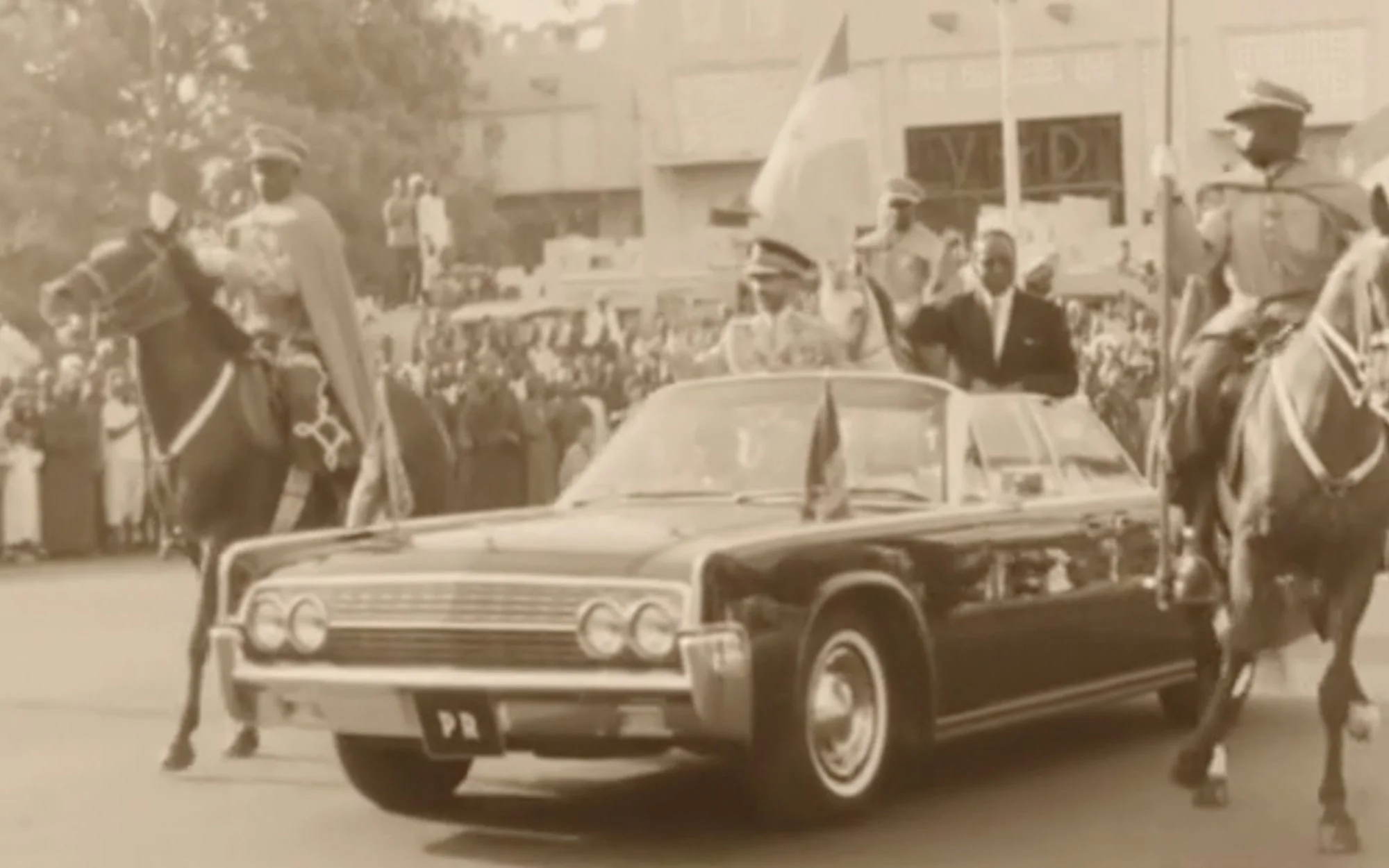
Abiba Coulibaly’s film programming at the Barbican Centre invites us to share in the dream of the great Pan-Africanists while having the uncomfortable conversations that come with it
Between the 1960s and 1970s, Pan-Africanism sat at the forefront of Africa’s political consciousness. With Ahmed Ben Bella, Kwame Nkrumah, Patrice Lumumba and many others leading the charge, it was a critical political movement that, in tandem, birthed radical forms of artistic and cultural expression across the Black world. This summer, the Barbican Centre’s Project a Black Planet aims to explore this phenomenon, unearthing the rich influence of Pan-Africanism on arts and culture over the past century. The three-month season circulates out from its major art exhibition to film and music, performances and discussions, all exploring the roots and trees of Black internationalism.
A big part of Pan-Africanism’s enduring influence is the intercontinental festivals that were held in its honour across Africa. Gatherings, such as the Pan-African Festival of Algiers (1969), Senegal’s First World Festival of Negro Arts (1966), the Tricontinental Conference (1966) in Havana and the Second World Black and African Festival of Arts and Culture (Festac 77) in Lagos, were integral historical moments embodying how the Pan-African ideals of community, justice and humanism could materialise through the lens of creativity.
It is these festivals that inspire Abiba Coulibaly’s programming for Project a Black Africa: Film. Focusing on the material change the festivals provided to both the indigenes of the nations they were hosted in and the diaspora who travelled there, the film programmer, writer and curator explores all the dreams and complications of Pan-Africanism. Her choice of landmark films, archive footage and new voices interrogate how we can move these foundational ideas forward in our contemporary moment.
Here, Nataal speaks to her about what this programming means for the season at large.
Your film programming mainly focuses on the idea of Pan-Africanism via its art and festivals. So, what does Pan-Africanism mean to you?
It is hard to say what it means to me because it feels so unmaterialised, and that’s what my programme is about in a way. It was a political ideology whose manifestation as a reality was awkward, difficult and incomplete. In terms of what it means to me, I wouldn’t go so far as to say it’s a failed dream or a failed promise, but something like a suspended project, really. For some people, it is a project that is historicised and doesn't have legs to stand on. For many other people, it’s something that they’re still very much keenly moved towards, even though it feels like there is less and less collective will for that to happen. In the simplest terms, it is the understanding of a shared struggle beyond borders. It is the benefit of moving towards something together despite differences within the continent, but also in recognition of how that can be expanded across the Global South or across the diaspora.
What role does your curation of films play in the wider festival?
I really hope it complicates it. Often, when there are exhibitions or any kind of cultural event related to Pan-Africanism, it’s quite celebratory and can at times romanticise the project. I don't think there's anything wrong with celebrating the political ideology and the aims behind it. But, particularly for younger generations who did not experience it directly and also for people living in the diaspora, it's a nostalgic concept. Whilst we can appreciate what it stood for and post beautiful vintage posters, archives and images of heads of state all together in one room, we also need to interrogate it. What was this really like in practice? How far could it go? What were the face-to-face encounters like? When the international elite descended on these African or Caribbean cities for the meetings, what were their experiences? When people from the African continent came to the Caribbean for the first time and when African-Americans came to Africa, how did the image they had in their mind and the kind of excitement that drove them compare to the reality on the ground?
But when I say complicated, it’s not to portray it as solely negative or dysfunctional. It's for us to look at all the different nuances beyond a surface level. And I think the nature of the films that I've chosen, and the people that I've chosen to have a conversation with, adds a critical dimension that the artworks alone, or captions that the artworks have, are not able to offer. That's what I hope.
There's this scene from Chimamanda Ngozi Adichie’s book, ‘Half of a Yellow Sun’, in which a character argues that Pan-Africanism is a Eurocentric idea because it tries to group all Africans as a monolith. Conversely, you wouldn’t say ‘Pan-European’. What do you think of this flip case?
That's a really interesting point. I wanted to explore some of those limitations as well. It was important for me to include the Pan-African festivals, starting with the Tricontinental conference that took place in Havana, which connects the struggles of people in Africa to those in Asia and in Latin America, while looking at the potential of Pan-Africanism to be in conversation with struggles across the Global South and formally colonised territories.
As you said, we don't really hear Pan-Europe or Pan-Asia. I actually think about the fact that Africa is the one region that has championed that Pan ideology, and how it resonates with wider struggles outside of it. It could be a model, but we could turn more inward and ask, does this actually even work as a grouping, as a category? Because we've got so many linguistic differences and so much diversity going on.
With the programme on Algiers [William Klein’s 1969 documentary ‘The Pan-African Festival of Algiers’ kicked off the season], I wanted to interrogate it as it’s the most famous Pan-African festival. There is a more recent documentary from 2011 called ‘Afric Hotel’, which is about the experience of Malians and migrants who are living in a hotel called Afric Hotel in Algeria. We play it alongside footage from the Pan-African Festival of Algiers in which you have signs saying “Welcome our African brothers and sisters”. There is also footage of Algerian men dancing with Senegalese women, which is beautiful to see. So, it's not just presenting Pan-Africanism as a legitimate concept that doesn't need its territories and boundaries questioned, but really looking at it at both the inward and the outward level.
“I wanted to speak to London as a microcosm of the world. It represents so many African and Caribbean communities who share so much exchange and curiosity about each other’s cultures"
Why do you think Pan-Africanism is not an ideology that's being struggled for as much anymore, especially in relation to the arts? Bob Marley would sing ‘Africa Unite’ but today’s voices rarely do.
Whilst I agree we're not seeing it reflected in culture quite as much, that doesn’t mean the social will isn't there, at least amongst my particular friend group and the people that I'm in contact with in London. In a way, I wanted the programming to really speak to London as a microcosm of the whole world. It represents so many African and Caribbean communities, meaning there’s so much exchange and curiosity about each other's cultures and wanting to visit the countries that your friends are from.
The cultural output has lost quite a lot of the Pan-African messaging, but the cultural structures, like FESPACO in Burkina Faso and the Dakar Biennale, are still grouping artworks under that umbrella. Because I think, despite the distance with time and how Pan-Africanism did not quite work out as envisioned, people amongst my generation are very keen to seize up on it within a wider conversation.
How do you think that Project a Black Planet season will help bring about this consciousness in modern times?
I got into culture because I believed that it could promote material change and invoke some kind of consciousness in the audience. However, the more that I have worked in the space, specifically working with film and seeing our relationship with moving images through social media, particularly in relation to the genocide in Gaza, I am actually having less and less faith in what visuals can invoke in us. I've often felt I may need to turn more to direct organising.
On the other hand, there's a lot of artwork, textiles and sculpture in the exhibition that showcases work conceived with really pressing questions in mind. And what’s special is the fact that we are seeing them all in the same place and creating a dialogue with each other. To be able to move through and connect the dots and the dissonances between work by African-American artists, with artists from Spanish-speaking parts of the Caribbean, with artists from Francophone Africa, paints a bigger picture than we are often presented with.
It’s an important thread we noticed in your work. For example, the programming related to FESTAC focuses on ‘Black Goddess’, the time-travelling epic made by Ola Balogun in Brazil a year after the festival.
In my programming, I wasn’t just thinking about the official happenings of these festivals and conferences. I was thinking about what was going on beyond the walls. What of the people who didn't have tickets or weren't invited, delegates or country representatives? What of the taxi drivers? How did these festivals and visitors interact? For me, it was going beyond the archival imagery we associate with these festivals.
There's actually a thriller called ‘The FESTAC Conspiracy’ that came out in 2024 and offers a direct recreation of FESTAC. But for me, Ola Balogun’s film was more interesting because I was thinking about all the conversations and encounters. I mean, you have an unprecedented amount of people from the diaspora come to Lagos and the year after the festival was when Nigeria got its first south-to-south co-production [with Brazil]. I don't know if that conversation came out of FESTAC directly, but it was more for me about imagining all of the different conversations between people from diasporas who had never encountered each other before. I wanted to show films that speak about all of the goings on of these festivals.
What do you hope the legacy of Project a Black Africa could be?
The only way we could continue the Pan-African ideology of the 60s and the 70s is if we have a thorough understanding of its limitations, the kind of ruptures that happened within it and where it went wrong. And I think it's clear how important the need is for cross-communal solidarity, not necessarily nationalistic solidarity. It's easy to look to the past and say, wow, things were great, especially with all of the independence era movements across the world. Why can't we recreate that or pick up where that left off? But the only way to pick up where that left off is to understand Pan-Africanism in all its depth and complexity. So, my main hope is that the programme gives us a better understanding of where things went wrong, so we will be more equipped to correct them the next time around. The next time around is here and very, very urgent.
Words Fawziyya Zakariyya and Jeremiah “Mansah” Abu-undiyaundeye
Visit Barbican Centre
Published on 22/07/2026