
Osione Itegboje, Omolola Coker, Caroline Useh on the threads that tie us together
Of Johannesburg’s many names, ‘eGoli’ is its most enduring. Meaning ‘place of gold’ in isiZulu, for its origins in the 1886 Witwatersrand gold rush, the title upholds the city as a beacon of economic promise and migration. Even the language itself, associated with the coastal KwaZulu-Natal province, underscores the city’s heritage as a site of aspiration – of opportunity, fortune and belonging in a place you can call home. Some 140 years later, Johannesburg continues to beckon people from across not just South Africa, but the continent and beyond. And RMB Latitudes Art Fair, an annual gathering of Africa’s contemporary artists, cultural practitioners, patrons, and art lovers alike, is a reflection of its centrifugal force with this year’s edition hosting the works of almost 250 artists and 30 exhibiting galleries.
At the same time however, renewed and more overwhelming Afrophobic protests, aggression and attacks against migrants are bubbling over across South Africa, Johannesburg included. With the theme Oasis, the 2026 edition of the fair isn’t a respite but a site of engagement with the beautiful and brutal past, present and future of Africa through art. Within this is the fair’s international platform, created in an effort towards inter-African dialogue and collaboration. Following 2025’s spotlight on Botswana, this year’s Nigeria Focus includes the works of almost 30 Nigerian artists and was first showcased at MÌLÍKÍ in Lagos in April. Co-curated by Yenwa Gallery’s Ugonna Ibe, and Latitudes curator Boitumelo Makousu, the special project demonstrates the breadth of the country’s visual arts landscape as well as acting as a conduit of understanding. For Ibe, the artist’s responsibility lies in creating “true, vast and nuanced” work that showcases the immediate concerns, realities and assertions of their inner and outer worlds.
Nigeria Focus asserts art as a form of commentary and record, offering honesty and vulnerability as tools for self-reflection and a gearshift of social change. The works also suggest art making as an act of repair and reflection on the personal and collective conditions of contemporary life. Of those exhibiting, Osione Itegboje, Omolola Coker and Caroline Useh harness fashion, textiles and dress to explore the human condition.
Osione Itegboje
Multidisciplinary artist and one half of slow-fashion brand This Is Us, Osione Itegboje describes himself as “a restless spirit.” His wild acrylic on canvas pieces, ‘Waterfall’ and ‘Amo-le-gbe’, continue his focused interest in “nature and the spirit that connects all of us,” he says. Despite these times of conflicting ideas and technologies set to divide us, “we must remember the things that make us human.”
“We must remember the things that make us human"
Osione Itegboje
Contextualising erasure’s effect on one’s existence, Itegboje explains that the works assert African identity and are a subversive reminder to ourselves that “we are not to be ignored.” Their abstract interpretation of nature offers a vision of unrestrained, unmarred and limitless living that contrasts with the homogeneous, colonial-informed social forces that “flatten our humanity,” he adds. From this, nature becomes a place of possibility and becoming. And colour plays a central role in this exploration. Just as Kano’s hand-dyed indigo has become synonymous with This Is Us, Itegboje’s two works employ green as an expression of his ongoing inquiry of humanity, growth and transformation.
If clothing functions as an outward expression of who we are, Itegboje’s paintings concern themselves with what lies underneath. ‘Waterfall’ and ‘Amo-le-gbe’ reflect a period of reinvention, charting an evolution of his style as a visual artist and deeper consideration of identity. The works are meditations on how we see, understand, and express our relationship to ourselves, one another, and the natural world that sustains us.
Omolola Coker
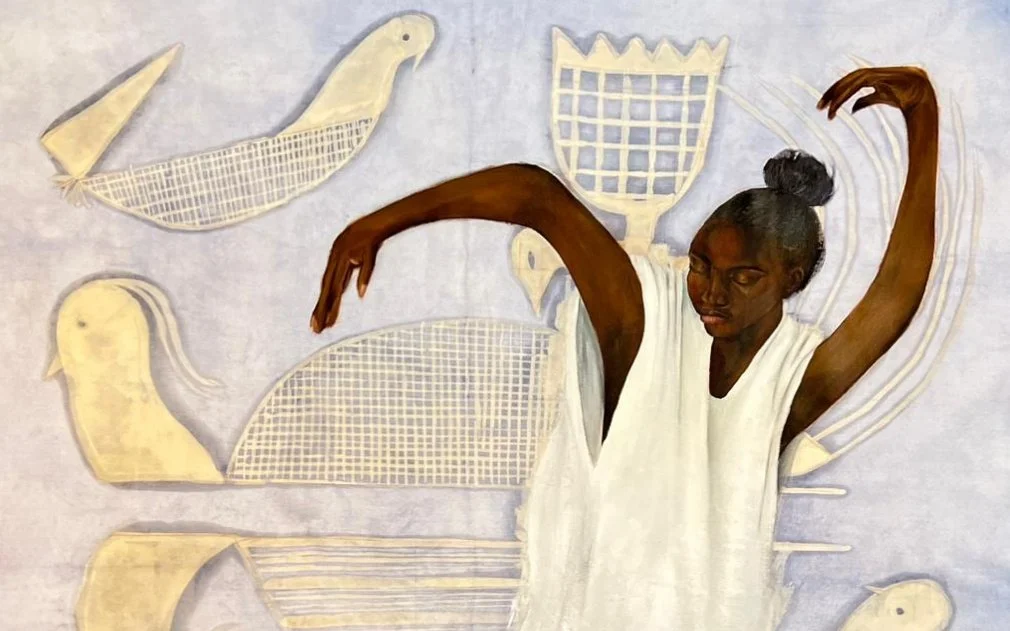
Omolola Coker uses the meanings held in sweeping bùbá silhouettes and àdìrẹ textiles as her as tools for aesthetic communication. “The story I want to tell was how ancestry speaks to us through fashion,” she says. “It holds heritage within its fibres.”
On moving back from the UK to Lagos in 2022, Coker felt prompted to engage with her sense of belonging. So, by combining oil and acrylic on canvases that have been wax-resist dyed, she employs textile traditions to create figurative works that explore the construction of oneself. “My work with batik is really a journey of returning home. It’s trying to engage with the spiritual side of finding myself, embedding myself in my roots, as a reflection of my inner voice.”
In ‘Planted II’, a figure dressed in a striking purple bùbá is surrounded by dense foliage. The setting was inspired by a park near her sister’s home in the UK where Coker used to go to meditate on the feeling of displacement she was experiencing as “a foreign object in a foreign land.” Here, the bùbá stands out as a symbol of femininity and cultural inheritance. So, rather than dwelling on alienation, the work points towards transformation. The figure is not lost; she is following a path. “Whether I know it or not, there’s something calling me back home,” Coker reflects. And rather than using existing àdìrẹ symbols in her works, Coker has developed her own. Inspired by the history of this matrilineal craft, she seeks to communicate “the internal thinking person” of her subjects, bridging spiritual and emotional realities with the physical world.
“Ancestry speaks to us through fashion. It holds heritage within its fibres"
Omolola Coker
While division threatens ideas of continental solidarity, Coker sees art as a space for connection. “Art is such a powerful expression; it’s the most authentic thing we have left.” Through shared visual languages and cultural traditions, her work insists that Africa’s strength lies not in sameness but plurality. “In a world where there’s so much fragmentation, I think the best way forward is to just show that we can hold each other.”
Caroline Useh
Approaching textiles as a metaphor for humanity itself, Caroline Useh has worked with discarded cotton bias tape to create ‘Fallen Rise’ and ‘To be’. Collected from local tailors in Lagos, Useh has cut, layered and assembled the strips into these two images of reclining male figures, building textures that reveal more the closer you get.
“We are a bit of material, and the material is a bit of us,” she says of her chosen fabric, which is usually used in garment-making to finish exposed edges, preventing fraying while providing structure, form and embellishment. As such, bias strips represent the emotional labour that goes unseen in holding families, relationships and communities together. It also hints as the ‘bias’ assumptions through which we navigate the world. Additionally, each strip bares traces of a previous purpose and path, much as people hold the experiences and emotional burdens that shape them. “I see each piece of material as carrying a soul of every human being,” Useh adds.
An environmentalist whose practice is rooted in recycling and reuse, Useh was drawn to bias tape precisely for its perceived disposability, mirroring broader questions of value, visibility and neglect. The material is a lesson in empathy and patience, and underlying it and the works is a philosophy of connection. Useh advocates for a softer and more intentional ways of being that privilege understanding and self-preservation alongside care for others. “You have to save yourself first before you have a wider shoulder for other people to lean on,” she explains. “You don’t have to collapse while trying to raise a nation.”
That sentiment resonates in ‘Fallen Rise’ and ‘To be’, which examine the emotional weight carried by men in particular. “Men also long for a shoulder to lean on,” Useh adds. The figures are still and fully present, formed by material once intended for outward appearance while asking us to ruminate on the unseen vulnerabilities that lie within us all. For Useh, art becomes a space to look beyond the immediate surface and reconsider what binds people together.
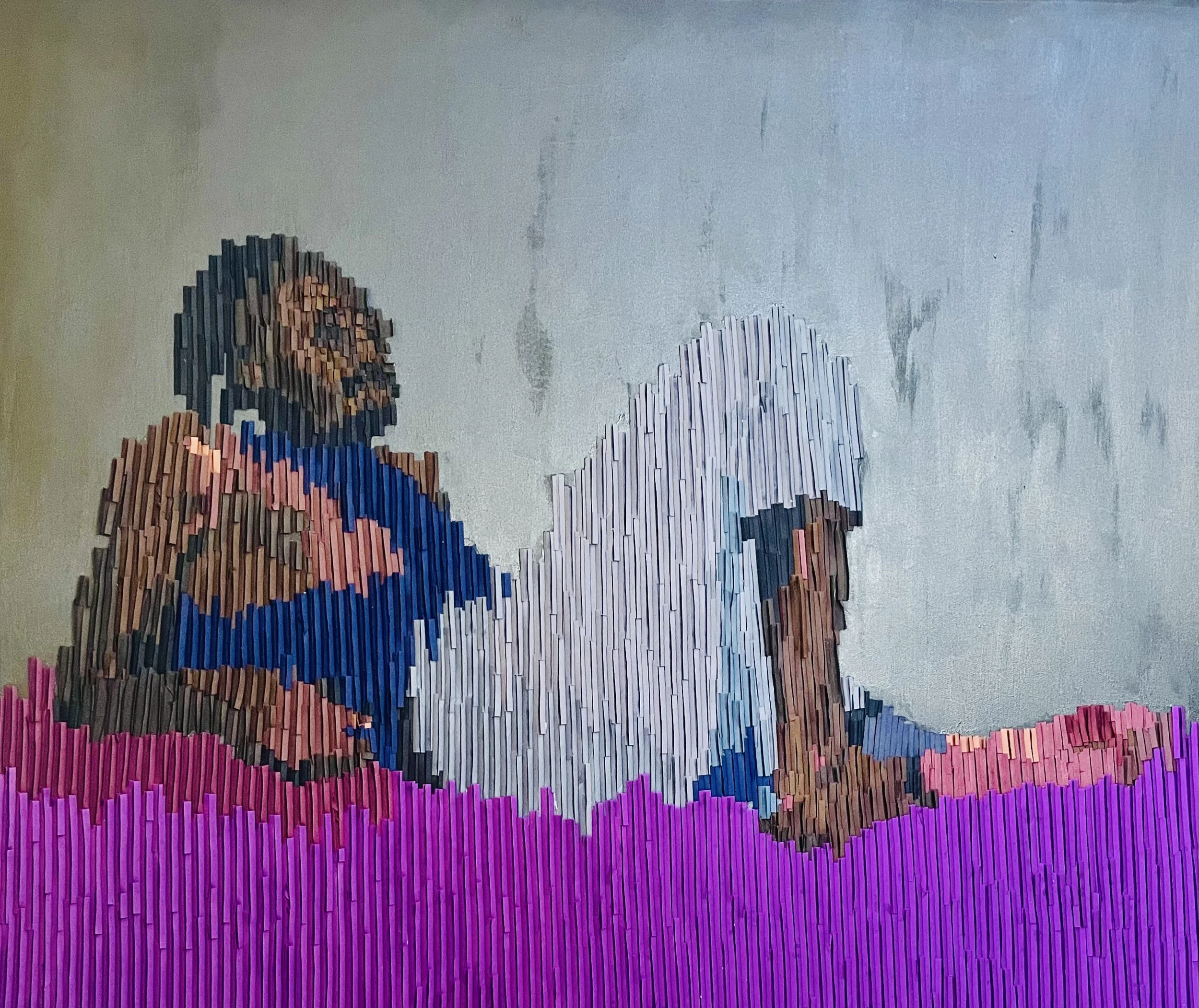
Caroline Useh, Fallen Rise
“I see each piece of material as carrying a soul of every human being,"
Caroline Useh
These three artists remind us of the ways that garments and our relationship to them operate as markers of affiliation, pride and resistance. Ibe notes that this concept of textiles as repositories of history and belonging is especially strong in Nigerian culture. “There’s so much that can be communicated and represented through fabric, so to see artists working with in a refined and intentional way is very exciting,” she says. With the country’s 36 states, Ibe adds that “the way we recognise each other is through fabric,” and the complexities of intersectional representation in Nigeria.
The politics of everyday dress also encompasses personal expression. Makousu suggests that fashion offers a means of negotiating the relationship to selfhood and society. “Your personhood shows through your clothing,” she says. This calls back to traditional techniques while also being a simultaneous undressing and excavation to reveal who we are beyond the differences we communicate and condemn. Textile practice is therefore way more than an artistic medium. It is a way of locating oneself within a lineage, recognising and remembering inherited cultural knowledge, and maintaining a connection to a place and people. These threads that bind physical fabric are a metaphor for the social ties that endure across generations and geographies.
Connections to self, spirit, society, fabric, family, and our natural home are so eloquently visualised by Itegboje, Coker and Useh. They not only ask us to pause and ponder what lies before us but to remember that, through art, there is common ground. All in their unique ways, they employ cloth as a repository of identity and a lightning rod for change.
Words Kemiso Yasmine Wessie
Visit Osione Itegboje
Visit Omolola Coker
Visit Caroline Useh
Visit RMB Latitudes
Published on 25/06/2026