
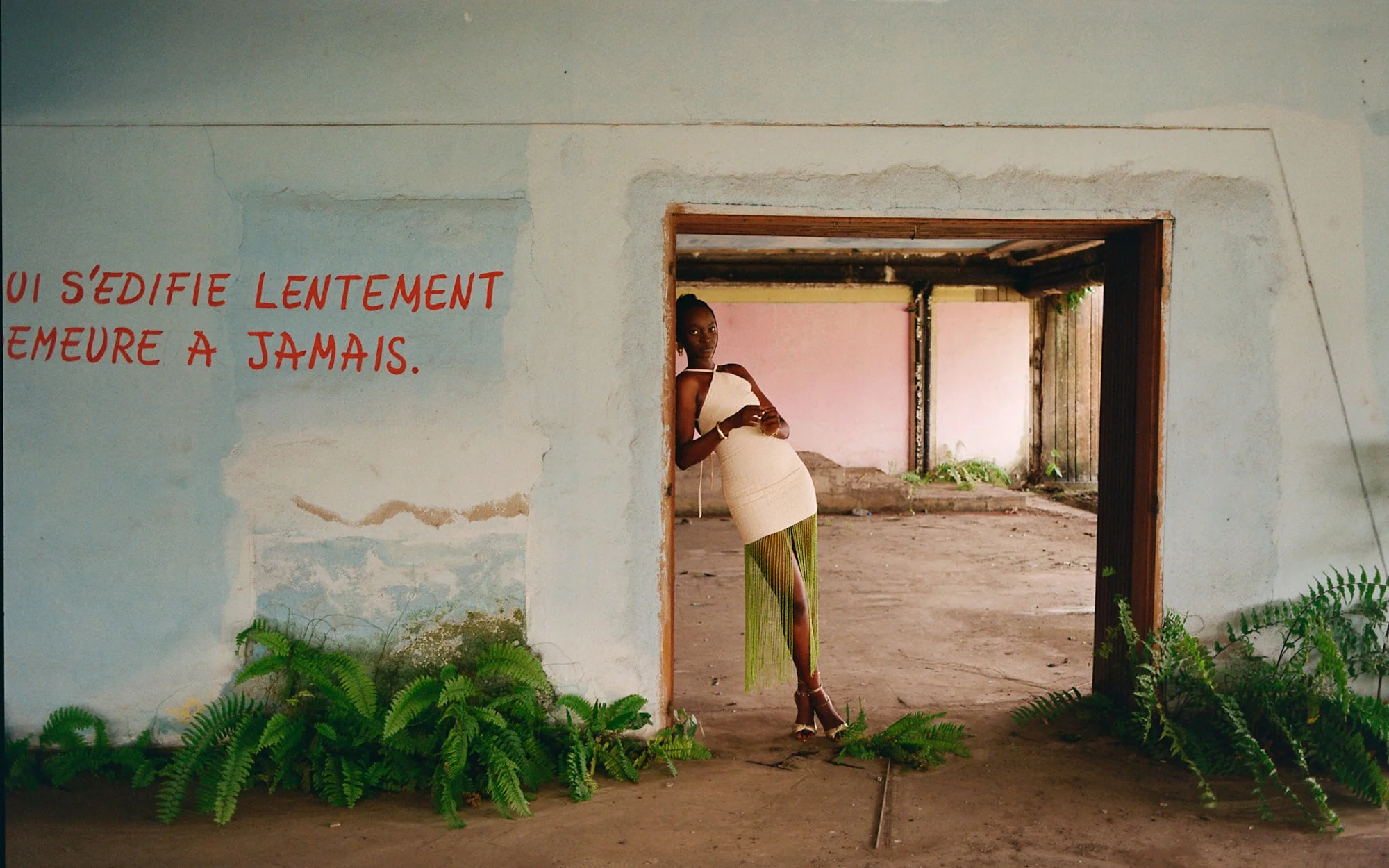
A transformational voyage through the monuments and memories of Abidjan
Safi Niang manifests in many worlds. The multidisciplinary artist was born in Guinea and works between Paris and Abidjan. Her practice spans image-making, textile, painting and creative direction, plus she’s platform-building as co-founder of the Atelier Ndokette collective. Through these collaborative disciplines and endeavours, Niang delicately explores the intersections of body, memory and material culture across the African continent and its diaspora. For NATAAL, the artist travels through Abidjan with photographer Brad Ogbonna – and in her own words – to encounter and embody the storied architecture of the city, from its modernist masterpieces to its living, breathing streets.
1973. Abidjan was becoming. The city expanded in every direction, its surfaces still warm from construction, its streets absorbing every arrival – languages, cultures, memories sedimenting into the texture of the everyday. Following the Independence from 1960, ‘La perle des lagunes’ was never a smooth surface. Its beauty was always in its depth.
This story did not begin with a place.
It began with a body — mine.
Before I ever thought of myself as an artist, I was a model. I learned to exist within frames imagined by others, to inhabit images, to give form to visions that were not always my own. I understood posture before I understood authorship. I understood how to be seen before I understood what I wanted to say.
But somewhere along the way, something shifted.
I realised that the same body I was offering to images could also become a tool to construct them. That I could hold the gaze, but also direct it. That I could tell stories, stories that mattered to me, through the very medium that first introduced me to image-making.
This editorial is a fragment of that shift.
Shot in Abidjan in January 2026, it unfolds at the intersection of body, memory and space. Because to me, buildings are not inert structures. They are containers of memory. They absorb presence, silence, passage. Much like textiles, much like the environments we move through and imprint without noticing. A threshold holds every body that has paused within it, every decision made in the in-between.
A wall remembers. A corridor carries footsteps. A space holds what has passed through it.
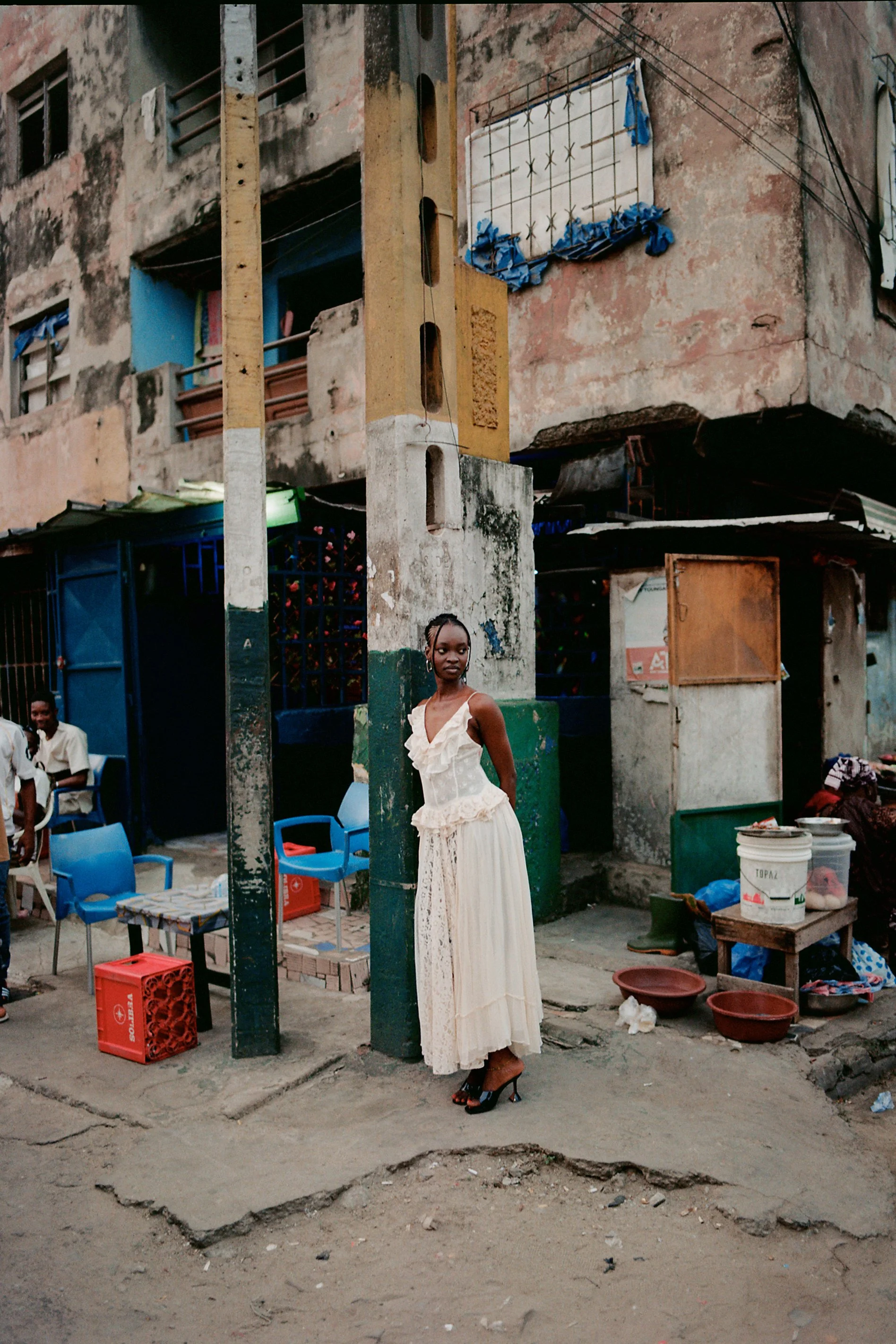
Safi wears own dress and accessories, Amina Muadi shoes.
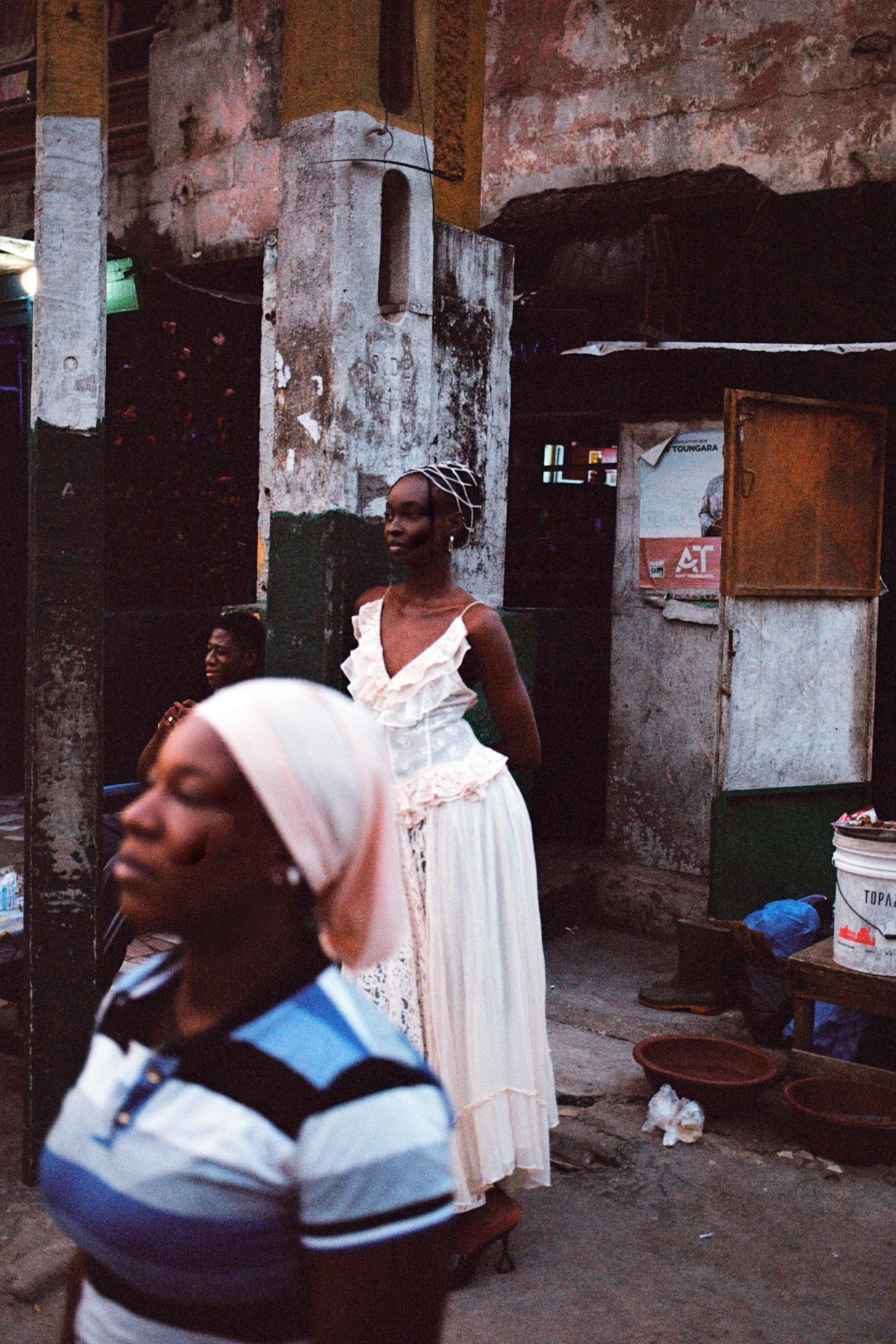
The journey begins at La Pyramide, designed by Rinaldo Olivieri. Silent, monumental, mythical in the way only abandoned ambition can be. A structure marked by time, written into the city's unconscious just the way certain losses become landmarks of our existence. There, the body meets architecture in its most stripped form, only breathing through the shade of the slanted brise-soleil.
From there, through the streets of Plateau, the city itself becomes a series of transitions. Regular rhythm, semi-jerky circulation, the texture of movement between two kinds of stillness.
We arrive at Résidence Roume, designed by DLM Architectes (also completed in 1973), where colour and form begin to echo the garments. The pillars, their repetition, their tones, create a dialogue with the silhouettes. Less opposition, more resonance. The body no longer confronts space; it begins to align with it.
The final movement takes us to Treichville, dense, alive, with a multi-layered presence, where surfaces carry the memory of those who passed through it and those who stayed. A place where geographies meet, where identities overlap, where structure extends beyond architecture into the social and the lives of in between spaces.
Throughout this journey, another element appears, quietly, almost familiarly: the ‘monoblock’ plastic chair.
An object so ordinary it often goes unnoticed, yet one that carries a powerful collective memory. Found everywhere, across our courtyards, streets, homes, gatherings, it holds bodies, conversations, waiting, rest. In this story, it becomes a counterpoint to architecture, much like what it symbolises for public space in Abidjan: a tool to reclaim space. Light where structures are heavy, mobile where buildings are fixed and intimate where spaces can feel rather monumental.
If walls remember, so do objects. And sometimes, they remember us more closely.
In this story, the body does not simply move through architecture. It listens to it, confronts it, dissolves into it, and eventually reshapes it. Clothing becomes an extension of structure: at times rigid, echoing lines and constraints; at others fluid, disrupting, restructuring and softening its own grid. The body negotiates its place within space, first adapting, then resisting, and finally rewriting.
Because to exist is not only to inhabit space. It is to transform it.
This project carries Guinea, Senegal, Ivory Coast, Nigeria. Different geographies, different energies, brought into dialogue through a shared act of making. The image becomes a meeting ground, a space where these territories echo and respond to one another.
I do not believe in creating alone. I believe in resonance.
Lately, my practice has been moving toward building platforms, spaces that allow encounters between creatives across the continent. I call this movement ‘Bridging Africa’. A way of thinking through culture as a connective force. A way of recognising that beyond our differences, there are shared rhythms, shared memories, shared urgencies.
Through image, through collaboration, through presence, we find each other.
In the end, the house is not only built of walls. It is built of bodies, memories, gestures, of those who gather within it.
And perhaps that is where it truly begins.
Creative direction and talent Safi Niang
Photography Brad Ogbonna
Styling Félix Edouard Kouassi
and Safi Niang
Co-production Félix Edouard Kouassi and JR.Sorho
Location scouting JR Sorho
Make-up Foba Ahia Marcelle
Fashion curation Aby Concept
and Safi Niang
Text Safi Niang, Nahoua Sorho
Fashion
Aby Concept
Amina Muaddi
Bee’s
Cekette
Christie Brown
Diesel
Lewa
Maison Kanty’s
Maïtey
Melissa
Meshki
Published on 26/06/2026