
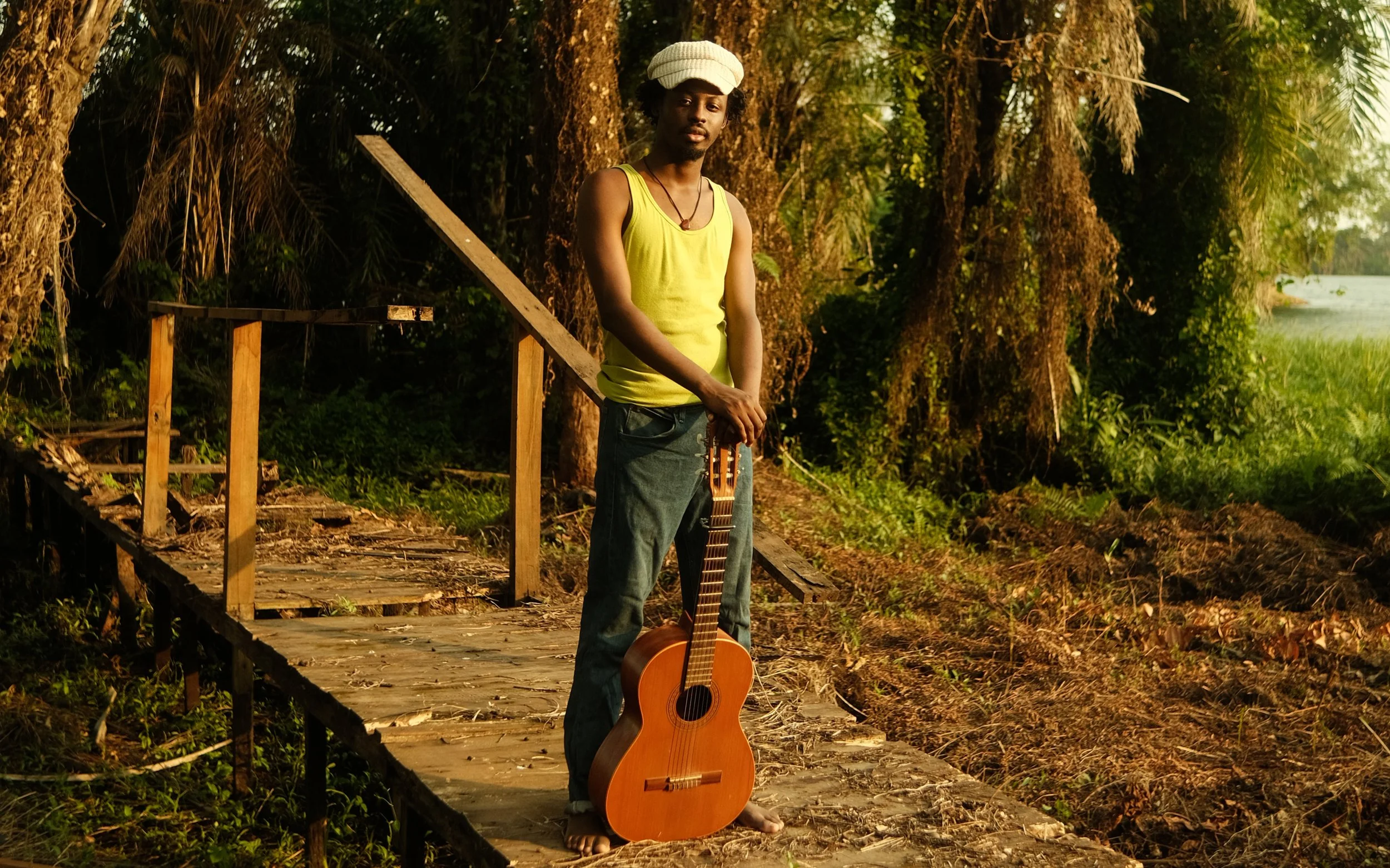
Tommy WÁ’s latest EP maps wanderlust, adventure and the art of belonging
Music moves us all. And it’s this movement that African folk and indie artist Tommy WÁ gently pulls listeners into. Born in Ibadan, his childhood was marked by frequent relocations around Nigeria. “That sort of voyaging does something to a child’s mind,” the now Ghana-based artist tells us. He sought balance within music, jazz specifically, which helped to moor the fluidity with which he found community in new spaces. This rich depth of experience reflects in his music. Rooted in wholesome folk melodies and raw authenticity reminiscent of icons like Beautiful Nubia, Majek Fahek, Bob Marley, and Lagbaja, Tommy WÁ’s work crafts a language of belonging while balancing nostalgia within a profoundly intimate world.
This world is where laughter rings from hearts warmed by campsite fires, the strums of guitar chords floating softly into the air as insects chirps in unison. There’s a call from the wild, there’s a yearning to unplug from the matrix and touch grass – a response rooted in wander and adventure. These nomadic sensibilities shape Tommy WÁ’s recent EP, ‘Somewhere Only We Go’. Where his 2023 debut ‘Roadman and Folks’ draws listeners into a fast-paced vibrancy of urbanity, this second chapter unveils a bucolic sensibility grounded in intention and honesty.
As Tommy WÁ goes on a UK tour throughout May, we convene with this troubadouring artist.
‘Somewhere Only We Go,’ feels both expansiveness and intimate. What does this title mean to you personally, and how does it capture the heart of the project?
The phrase came about in 2021. I just moved to Accra from Kumasi. At the time, I was one of the few Nigerians living in the city; most of my friends had moved back to Nigeria. Thankfully, some people would invite me on trips. We travelled around Ghana; sometimes to a beach, other times to a lake, or a mountain. While we were on these trips, I observed that this type of activity wasn’t mainstream, and so I got the idea for ‘Somewhere Only We Go’.
This became the first event in Abuja. We went hiking in the mountains and met some villagers along the way who joined our group. We played a show right in the middle of nowhere. From there, it started growing. We had another in Ghana, with about 10-15 friends, and then it grew into an annual event held every New Year’s Eve. I wrote songs and shared them in these settings, and that's how the project came about. The melodies just came, and thankfully, I was able to capture the fullness of the experiences we had on these trips in it.
From Abuja to Kumasi to Accra, we laughed and cried together; we saw people's unfiltered selves. We weren’t all close friends, but we shared a common goal of reaching a destination, which strips off ego and creates space for vulnerability and openness. People sang as loudly as they wanted, and they danced without performativeness. The project is a soundtrack to our collective human experiences.
“I do my best to be rooted in the value of community; observation, listening, the service to friendship and collective responsibility"
What practices or rituals help you to ensure that your arts stay rooted in warmth and camaraderie rather than detachment or performance?
In all honesty, I do my best to be rooted in the value of community; observation, listening, the act of service to friendship, to collective responsibility. I make sure to be intentional about my friendships, and this has helped me preserve the ethos of what I'm trying to bring with my music that these experiences exist in Africa alongside afrobeats music.
The guitar is the central instrument on this set of songs, but what other sonic elements joined the heartbeat?
The expression of this project was carried through movements. The energy and rhythm in ‘God Loves When You’re Dancing’ were inspired by a friend who is a dancer, so we can say that the flow of the human body was instrumental. For ‘Somewhere Only We Go,’ it was a one-take guitar, and we spun some synthesizers on it. The percussion on ‘Celestial Emotions’ was inspired by the drum patterns and multiple-layered percussion on Lagbaja’s ‘Never Far Away’.
“I want people to leave my live shows with a sense of adventure and curiosity for the world around them"
The opening track ‘Operation Guitar Boy’ pays homage to Sir Victor Uwaifo’s 1966 classic ‘Guitar Boy’. What drew you to this reference?
It was intentional and necessary because of my relationship with Ghana. The song was one of the biggest songs in Nigeria at the time and had found its way into Ghana. In 1969, Ghana experienced a coup, and the military adopted the name Operation Guitar Boy, which led to the song being banned in Ghana at the time. Kotaka Airport is also named after the man who died in the coup. The track is both a tribute to Victor Uwaifo and, most importantly, to the lives lost during that period, which heavily influenced the sombre elements of pure guitars and vocal manipulations on the track.
What role does the idea of home play in your artistry?
Home is community. Home is the people I call friends; wherever my friends and family are is home. I've never really stayed in one place. Even in Accra, I’ve lived in up to 10 houses, so for me, home is ever-changing, and it influences the music. As home isn't a stationary space yet for me, my definition of it isn’t the most common understanding. And it will be like that for a while, as I'm currently on the road playing shows, moving from city to city, and experiences those places. So, the only constant is family.
What do you hope ‘Somewhere Only We Go’ evolves into for your listeners in the long term?
I hope people can look back on it with so much fondness, as something that evokes nostalgia. In 20 years, I especially want folks I worked with on the project, to listen to these tracks and remember a point in our lives where we expressed ourselves fully and found beauty in community. I want this to be a memento to pass on to the generation after.
You are currently on tour, what kind of atmosphere are you offering to people at the shows?
I want people to step into a world of authenticity and collectiveness. The setting for the shows already carries a semblance of nature and community so I want people to leave with a sense of adventure and curiosity for the world around them. I want my shows to serve as a medium of connection and new friendships. A space for honesty and vulnerability; where people feel safe and find rest. I want people to leave my shows with a sense of wholesomeness.