
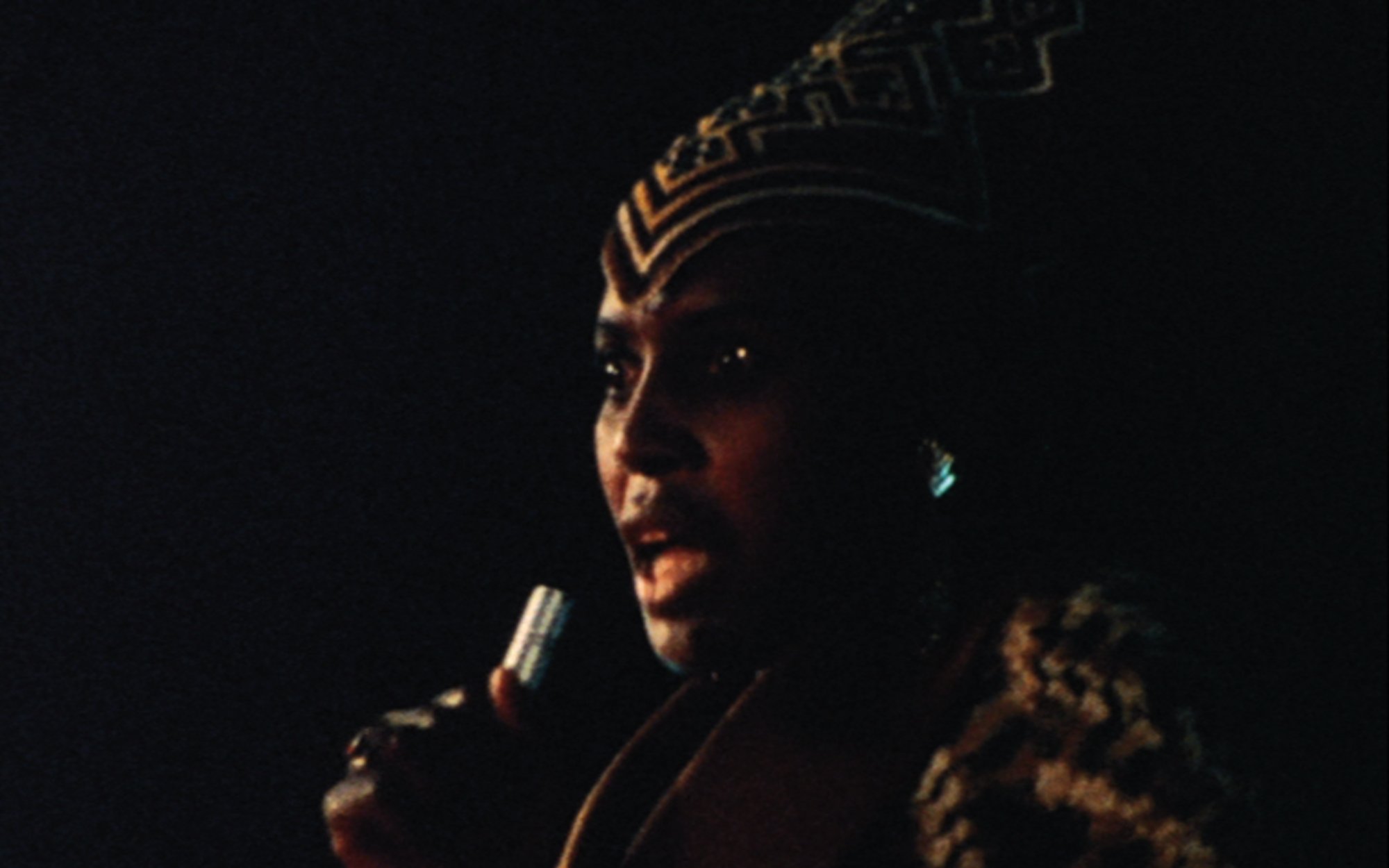
The Pan-African Festival of Algiers, William Klein and keeping an archive alive
I’ll admit it: until 2022, almost everything I knew about the 1969 Pan-African Cultural Festival of Algiers could have fit in a couple of paragraphs. I’d seen images of old posters, read poorly translated French to English articles and gathered and gathered enough of its broad outline to know the shape of the shadow it cast online. But its full form still hovered at the margins of my understanding.
That changed in Professor Salah M. Hassan’s office at The Africa Institute in Sharjah.
I was coming to the end of my time there as a Tejumola Olaniyan Creative Writers-in-Residence fellow when I was invited to meet Prof Salah, the Institute’s founding director in his office. By then I knew the building well enough to move through it without thought. I knew where people disappeared to after talks, which corridors stayed coolest in the Sharjah heat. But I’d never known his office.
Some invitations that are technically ordinary gather meaning on the way towards them. The walk up to the top floor had that quality. Three months of reading, writing, listening, trying to make something worthwhile, and now a one-on-one meeting with Prof Salah at the end of it. A small threshold, really, but the ambitious scholarly mind is very good at making gardens out of these things. Discovery flowers here. Wisdom blooms there. Somewhere in the middle: approval.
We had been talking about the composite novel I was working on during the fellowship when the conversation drifted, as it often does with me, towards Algeria. We spoke about the country’s place in the history of African liberation and continental solidarity. The conversation had just loosened into that nice place beyond the formal meeting when Prof Salah asked what I thought of William Klein’s Festival Panafricain d’Alger 1969.
“The what?”
There was a pause.
A look.
You know the look.
There goes my approval.
He got up from his chair and walked over to his shelves – books, monographs, exhibition catalogues, the paper trail of a life spent thinking about African art – and went straight to a precise spot. He knew where it lived. Out came a red box. He brought it back to the table and set it down between us.
“You haven’t seen this?”
I had not. I knew of the festival, not of the film.
I am Algerian.
This made matters worse.
He turned the box over in his hands and began explaining what was inside it: Algiers. July 1969. Africa and its diaspora descending on a city only seven years out from independence. Musicians, politicians, dancers, writers, filmmakers, revolutionaries. Miriam Makeba. Nina Simone. Archie Shepp. The Black Panthers. Amílcar Cabral. Agostinho Neto. Delegations from liberation movements representing countries that, technically, did not exist yet because they were still fighting to bring them into existence. It was 12 days in which African culture and politics swirled so closely together that nobody seemed particularly interested in pretending they were separate things.
All caught on film. All sitting in that red box between us. Its full form, unseen.
Another threshold had appeared, flowering with its own possibilities: to see this history in motion, to hear what the written record could not hold, to watch Pan-Africanism move and dance through the streets of my own country.
Now I needed to see it.
Somewhere in Prof Salah’s telling of this documented Pan-African display, the box in front of me had stopped being a DVD and taken on the lustre of ruby. Whatever studied composure had made it up the stairs did not survive that transformation:
“Can I borrow it?”
Another pause.
That same look.
“No.”
Fine, I thought. I’ll get my own.
I had assumed, with Gen-Z arrogance, that everything existed somewhere online if you looked hard enough. A copy for sale, an archive login, a distributor stream, some route in. There would be a way.
Except, in 2022, there really wasn’t. Or at least not one I could find.
Back then, I’d only found references to the film. Short clips on YouTube. Articles mentioning it. People who had seen it. People who had written about people who had seen it. Dead listings. Promising links that took you to an ‘unavailable’ page. Strange corners of the internet suggesting that, once upon a time, somebody somewhere had owned a copy.
Seeing the film remained just out of reach. I was trying desperately to understand an event through the traces it had left behind, while one of its most important visual records sat somewhere beyond my access.
And then, a year later, I finally did.
On Algerian Independence Day in 2023 at the SAFAR Film Festival in London, I sat down at Ciné Lumière and watched Festival Panafricain d’Alger 1969 for the first time. After all those dead links, fragments and second-hand descriptions, the thing I had been chasing was suddenly there, moving in front of me.
The red box had finally opened.
Almost immediately I was hit with something I hadn’t expected.
Klein does not begin with the colour and pageantry that have come to define the festival in its surviving photographs. He begins with the wound and the question of what it means to be African after colonialism. Algeria sits at the centre of this story, only just out of a war of independence so brutal that its violence had produced its own vocabulary of trauma. The film makes you sit with this before it allows you the festival because liberation, before it could be celebrated, had to be remembered as something people had died for.
Then Algiers erupts.
The streets fill. Delegations from across Africa, its diaspora and its allies arrive. Flags appear: green, red, gold, black. Drums, brass, fabric, voices and crowds move as one through a capital whose walls still bore bullet holes.
On that first viewing, I began to see what the festival meant by culture as a living political force. Klein keeps cutting from processions and speeches to stages, rehearsal rooms, dancers, musicians, actors, crowds spilling into the streets. Plays unfold in fragments: some confronting empire directly, others drawing on stories and moral worlds that had survived long before anybody thought to call them “heritage.” For a moment, African culture is not being explained, translated or exhibited for somebody else. It is simply everywhere.
“To restore a film is not simply to rescue its physical body. It is to return it to argument"
President Houari Boumédiène had opened the festival declaring culture a weapon in the struggle for liberation. In those twelve days, Algiers behaved as though it believed him.
This is what the film gave me that the articles and photographs never quite had: raw spirit. The sensation of a political idea passing through people, stages and streets. Pan-Africanism, usually handed down to us as an ideology, suddenly came alive.
It moves. It sings. It dances.
And then, predictably, I became unbearable about it.
I yapped about the film, posted clips with commentary on my Instagram. I started collecting antiques from the festival – books, programmes, posters, vinyls, whatever I could find. I started encouraging friends to do the same with material from their own countries, to look for the objects, images and records through which their histories had survived. Despite my best efforts I could only get my hands on my own copy of the red boxed film when a collector friend gifted it to me. Friends would then come to my house and, at some stage in the evening, find themselves being told that there was something they simply had to watch.
I’d give them that look. “You haven’t seen this?” Passing it on, essentially, the way it had been passed to me.
Something important was happening. The film was travelling. From Algiers to a reel. From a reel into archives. From restoration into a red DVD box in Sharjah. From Prof Salah to me. From a London cinema into my living room, then out again through whoever I could convince to sit still long enough to watch it.
That movement is the difference between preservation and an archive that is actually alive. Preservation had kept the film. Circulation had returned it to an audience.
While Prof Salah was sending me down this particular rabbit hole in Sharjah, someone else on the same fellowship was already thinking much more seriously about exactly this problem.
Ruun Nuur was one of the other fellows in our inaugural cohort, an independent cinematic practitioner whose work was rooted in Somali and African cinema. She was tracing 20th century Somali cinema – its pioneers, collaborators and, crucially, where their work had ended up.
Ruun and I had many conversations about restoration during those months. I understand them better now. Earlier that same year she had written about film restoration as a form of activation. The restored object was not supposed to emerge pristine from a laboratory only to be returned to another shelf. Screenings, conversations, audiences: these were part of the life cycle too.
Activation is the better word.
Because to restore a film is not simply to rescue its physical body. It is to return it to argument: another audience, another political moment, another generation capable of finding something in the frame its first viewers did not. A restored film gets to become contemporary again.
In this precise way, the festival's cinematic afterlife continues to unfold. Until September 6th the Barbican is running Project a Black Planet: Film, a programme exploring the movement of PanAfrican ideas through cinema, art and cultural practice. It opened with a screening of Festival Panafricain d’Alger 1969 and will return to the same twelve days in 1969: an Algerian newsreel of the festival, screened by Nabil Djedouani. He runs Archives Numériques du Cinéma Algérien, an open-access platform for the country's lost and forgotten cinema.
The festival keeps resurfacing elsewhere too, in January this year, New York’s MoMA hosted the US restoration premiere of We Came Back (Archie Shepp Chez Tuaregs), Ghaouti Bendeddouche's 1969 film following Shepp's return to Algeria after the festival. It had been presumed lost yet was restored in 4K in 2023 and has only recently begun travelling again. The archive around Algiers is still being activated.
This has particular weight in African cinema.
Since the early years of independence, African filmmakers have used cinema precisely to wrest the continent’s image away from colonial narration, to offer African perspectives on African histories and political life. Which is why, for African cinema especially, restoration is not some quaint side department of the form, nor simply an expensive labour of love undertaken for art’s sake.
It is political work.
Yet there is a line here that needs to be handled carefully, because film, even when it feels more whole than testimony, scattered images and artefacts alone, does not give us history untouched.
Klein’s film certainly doesn’t.
He was a French-American filmmaker commissioned to document a fiercely Pan-African gathering in a newly independent African state. His camera chooses where to look. His edit decides what remains. What reaches us is not the event itself, but an event already shaped by perspective. Elaine Mokhtefi, who was actually in Algiers working inside the Ministry of Information, later called the finished film an “indigestible flop” in her memoir. Ousmane Sembène was among those who objected to the logic of handing an event of this kind to a white American filmmaker in the first place.
So no, a camera is not truth, and Klein’s film has a position. It surely excludes as much as it preserves, and every surviving frame carries some trace of what he chose to keep.
But that does not make access to the material less important. It makes it more so.
Film does not remove mediation; what it can do is give us more with which to confront it. We are no longer left only with somebody else’s account of what happened. We can watch what survives, notice what is absent, sit with the contradictions, and decide for ourselves what we think it means.
A later historian can tell me that 5,000 international participants marched through Algiers. A photograph can freeze one beautiful second of it. Film gives me the awkward bits around the edges. How long the procession takes to pass. How people occupy the pavement. Who looks bored. Who looks thrilled. How a dress moves when someone starts dancing. The cadence of a speaker’s voice. The crowd’s response before anybody has had 50 years to decide which parts of the speech mattered.
This matters particularly when so much of African history has reached Africans only after first passing through somebody else's archive, language or country. Who holds the reel matters because it helps determine who can encounter it.
But possession is only part of the problem. A film can survive perfectly well in an archive and still disappear from public life.
Klein's film is a case in point. It appeared in the Directors’ Fortnight at Cannes in 1971 but remained unseen for decades; contemporary accounts of its 2009 return described it as rarely projected and at times virtually unobtainable. That year, 40 years after the original festival, it was screened again in Algiers during the second PANAF, with ARTE involved in the film’s renewed circulation.
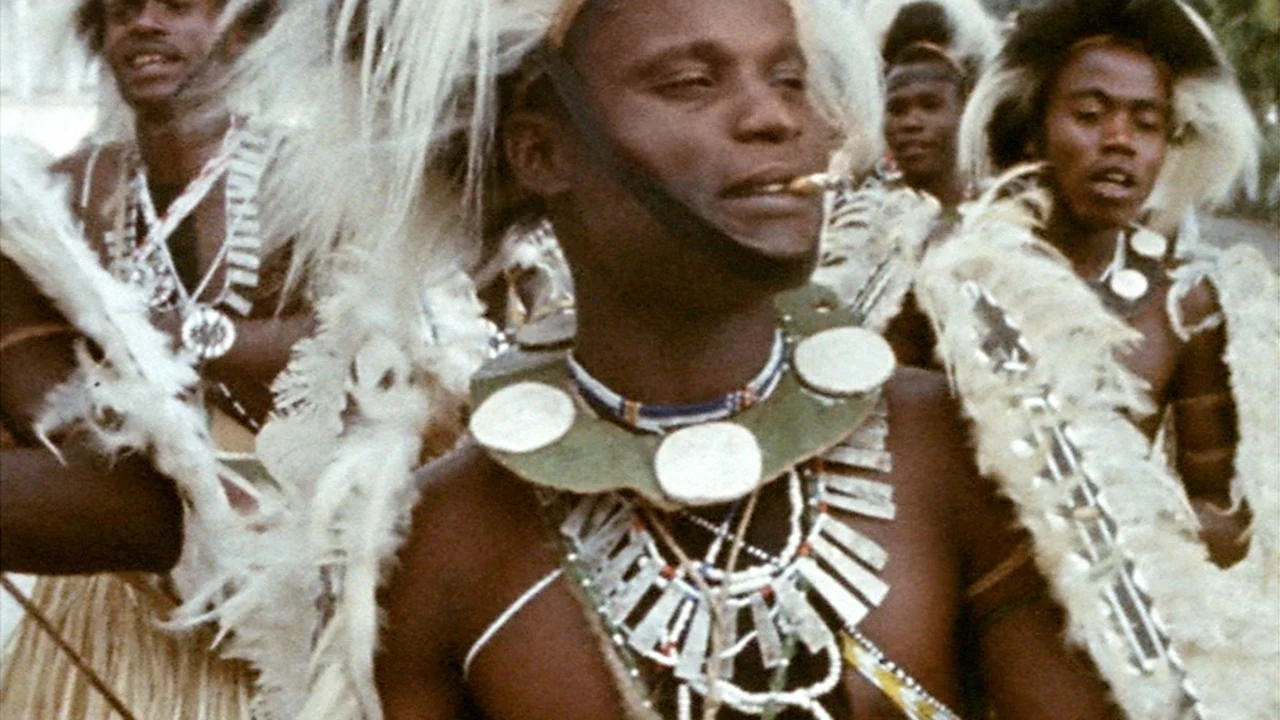
The reel had survived.
The relationship with an audience had not.
That is what restoration can repair.
Not history itself. The route back to it.
And what came back into view with Klein’s film was not just a festival. It was a political imagination.
Pan-Africanism is an awkward thing to define because, at its most convincing, it is almost visceral. There is the intellectual history, of course: definitions, conferences, congresses, statesmen, manifestos and the African Union. But then there is the feeling underneath it. The recognition that what happened to us did not happen separately. That the languages of colonialism may have differed, the flags may have differed, the borders may still divide us, but there is enough shared history and culture to make curiosity about one another politically useful.
The generation that gathered in Algiers understood shared culture as one of the places where freedom had to be made. What we inherit from them is not only the material they left behind, but the responsibility to keep it in motion.
Perhaps that is what Prof Salah really handed me that afternoon in Sharjah.
Not the DVD. He was quite clear that I was not getting that.
He handed me the knowledge that the footage existed. Which, it turns out, was enough.
Four years on, it is considerably easier to come by than when I first went looking. Not because the reel was suddenly rescued (it had survived long before I knew to search for it) but because more roads lead back to it now. A screening here. An upload there. A programme. An essay. A twisty conversation lingering outside the cinema post credits. Enough little routes for the thing to keep moving until another young scholarly mind hears:
“You haven’t seen this?” – half scandal, half invitation, the tone that sends them home to look it up that same night.
Maybe that is activation in its simplest form: a seed palmed to whoever’s next. If it is tended well then somewhere, something flowers.
Words Sara Yassi
Visit Barbican Centre
Published on 26/08/2026