
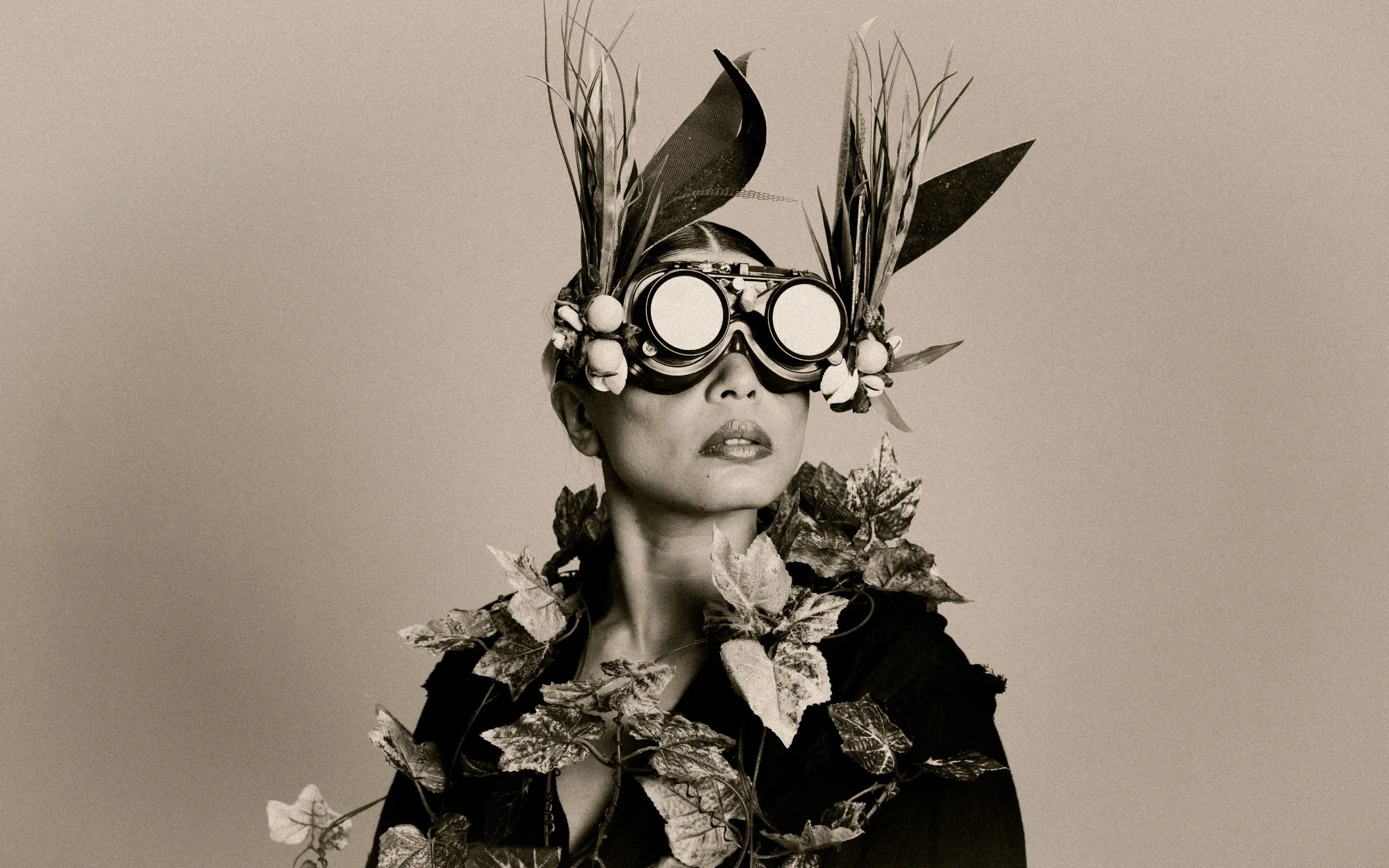
The Brazilian artist, filmmaker and activist on spirituality as the life force for her work
Life led Zahỳ Tentehar to her calling when, ten years ago, she was speaking in her native language at a social justice gathering and was subsequently cast in a Brazilian miniseries. Since then, her star power has continued to grow as she has lent both her acting and writing talents to television, cinema and theatre productions. Tentehar’s artistic trajectory is not only inspiring for her pioneering work representing Brazil’s different indigenous languages on the world stage, but also for the ways that she’s found to reflect her own identity as a member of the Tentehar people.
In her autobiographical play, ‘Azira’I’, which was also recently published as a novel, the artist recalls memories of her mother Azira’I Tentehar, the first woman chosen as a pajé (spiritual leader and healer) in the Cana Brava indigenous territory of Maranhão. “There’s a place of great power when, even with all the limitations imposed on us, we take the lead and decide that we don’t want the story of our people to be told in a certain way. We have our vision, our way of life, creativity and creation,” she says.
Through music in the play, the actress explores the nature of the mother-daughter relationship, reflecting on the past and the present, tradition and rupture, and between life and its continuity.
Part of the performance is done in Ze’eng eté, or truespeech. Using her mother tongue and avoiding literal translation, allows her to remain faithful to the meanings intended. Doing so also reveals how much indigenous linguistic diversity remains unknown to most Brazilians – one of the consequences of colonisation.
The memory of her mother is exalted in her piece but for the artist this bond goes further; just as her mother was chosen as a pajé of her village, Tentehar considers herself a pajé in the arts. “I have a great affection for the spirituality that my family has developed. Our pajés are chosen by the maíras (divinities), our enchanted ones, and not by humans. When I say that I am a pajé in the arts, it is because everything I do is very connected to my spirituality. When I am on stage, or I am going to record something, I go into a trance. For me, acting and creating is very sacred. People may think that sounds romantic or mythical, but this is my way of creating.”
“When I am on stage, I go into a trance. For me, acting and creating is very sacred"
For her, creativity does not stem from doing something just for the sake of it – to look busy or keep up with ones peers. It’s an exercise in wellbeing and self-preservation. “In the big city, we are constantly being judged, whether by the company or by your colleagues, which puts you on alert. This can be a good thing since it helps you to develop your skills but it can also make you sick if you’re constantly comparing yourself to others. Production has become synonymous with creativity, but in the end, you are increasingly ceasing to be yourself.” In this way, her work constitutes a space for healing. “It only makes sense if people can connect with me. And that’s about transcending the real state. Pajés heal through song, hands or herbs. So, I want to improve our health through art. Life will only make sense to me if people can heal themselves.”
Both her work and reflections on her journey are an invitation for other people to genuinely connect with her story, from a place of surrender, and often without the fear of being vulnerable. “There is an overvaluation of the traditional education that individuals receive, which is designed according to a specific model that excludes other modes. But I believe that the most genuine is self-teaching, which is a very powerful characteristic of Indigenous peoples. Our learning come from the way we see and do things; this is our first education.”
This is not about her belittling formal paths, rather going way beyond them as her transdisciplinary horizons ever-grow. “My position is more about including other perspectives on education, considering those that have always existed in this territory, long before those based in other places, that try to unify people in a way that is actually productive for capitalism.”
Visit Zahỳ Tentehar
Words Ana Rafaella Oliveira
Photography Isadora Relvas and
Philipp Lavra
Creative direction and styling Rosina Lobosco Farath
Beauty Victor Dargains
Fashion Osklen
Published on 26/06/2026